

Audio By Carbonatix
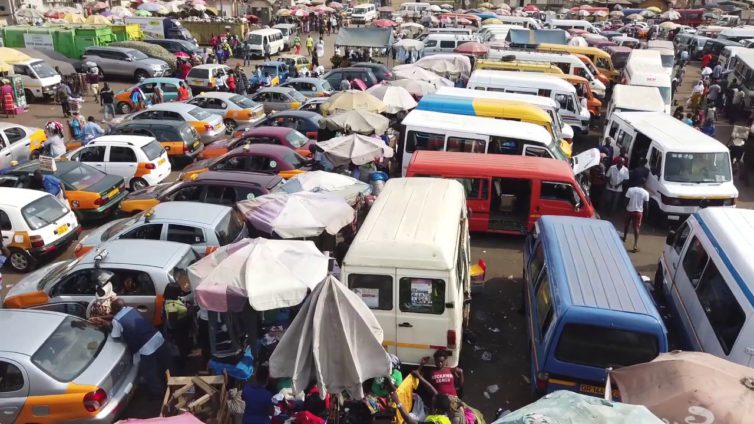
The Ghana Private Road Transport Union (GPRTU) has defended its decision not to reduce transport fares despite a slight drop in fuel prices, stating that fare adjustments depend on multiple cost factors beyond just fuel.
Speaking on Joy News’ PM Express on Tuesday, March 18, the Deputy PRO of GPRTU, Samuel Amoah, explained that spare parts, insurance, DVLA charges, and other operational costs play a critical role in fare determination.
“Before December, we had plans of increasing transport fares, first because of the high cost of spare parts, where the fuel price was also running to, the cost of lubricants, insurance, and DVLA taxes,” Amoah stated.
“But then we held it. We held on, thinking that things would come down because of the promises we had that going forward, things were going to get better.”
He acknowledged that fuel prices have seen a slight reduction but argued that it is not enough to warrant a fare decrease.
“Yes, we have seen that fuel prices are coming down a little bit. But what I can say is that it has not gotten to where it will call for a reduction in transport fares.”
Amoah stressed that fuel prices are just one of many variables considered when deciding on fare adjustments.
“We don’t only consider fuel prices to determine our transport fares,” he explained.
“We have some other components, like the cost of spare parts, as I earlier mentioned. We have the cost of lubricants, taxes, and other petroleum products as well.”
He outlined the process GPRTU follows before making any fare changes.
“We normally have a 10% threshold that we check on,” he said. “We compare where the fuel price was and where it has gotten to.
"Then, we send a team to the market to check where the prices of these other components have moved to. Based on their reports, we determine whether there should be a percentage reduction or an increment.”
According to Amoah, the last time transport fares were increased, fuel prices were around ¢12 per litre.
“If you check the previous time we increased transport fares, I believe the fuel price was around ¢12 per litre, thereabout—I stand to be corrected,” he said.
“Looking at it now, diesel is about ¢15.49, and petrol is about ¢14.99.”
He made it clear that until fuel prices drop significantly, fare reductions remain unlikely. “We are praying that fuel should come down to at least around ¢12 per litre,” he stated.
“If it comes down to that level, we will also check where the spare parts prices have gotten to. But with where the cost of spare parts is now, it will be difficult for us to reduce transport fares.”
His remarks highlight the complex nature of transport fare adjustments, reinforcing GPRTU’s stance that reducing fares is not solely dependent on fuel prices but also on other operational costs affecting transport operators.
Latest Stories
-
BOG put GH¢4.69bn into gold-for-oil, lost over GH¢2.1bn with no impact — Audits show
9 minutes -
CRC opted for broader reforms over abolishing ex-gratia – Charlotte Osei
27 minutes -
Mahama’s record shows four-year presidential term is sufficient – Inusah Fuseini
33 minutes -
Four-year term enough for accountability – Inusah Fuseini
41 minutes -
CRC Proposals: We were very mindful not to create problems while solving existing ones – Charlotte Osei
50 minutes -
Ebo Noah’s ‘faith’ or Climate Change: Rains on Christmas eve and day in Ghana?
1 hour -
Dr Seidu Jasaw commissions CHPS facilities in Chaggu-Paala and Tuosa communities
1 hour -
Charlotte Osei describes CRC work as “a privilege of a lifetime”
2 hours -
Ablakwa inaugurates SMART classrooms for STEM education
2 hours -
Livestream: Newsfile discusses Constitution review report and AG’s ORAL drive
2 hours -
Michael Adangba Legacy Music Festival pulls huge crowd for maiden edition
3 hours -
MTN spreads Christmas cheer to newborns in Takoradi hospitals
3 hours -
Kumawu MP celebrates Christmas with drivers and riders
3 hours -
DeThompsonDDT earns six major nominations at 2025 Western Music Awards
4 hours -
Kumawu MP shares Christmas with aged, widows in constituency
4 hours