

Audio By Carbonatix
US President Donald Trump has signed an executive order aimed at removing some of the legal protections given to social media platforms.
It gives regulators the power to pursue legal actions against firms such as Facebook and Twitter for the way they police content on their platforms.
President Trump accused social media platforms of having "unchecked power" while signing the order.
The order is expected to face legal challenges.
Legal experts says the US Congress or the court system must be involved to change the current legal understanding of protections for these platforms.
Mr Trump has regularly accused social media platforms of stifling or censoring conservative voices.
On Wednesday, Mr Trump accused Twitter of election interference, after it added fact-check links to two of his tweets.
On Thursday, Twitter added "get the facts about Covid-19" tags to two tweets from a Chinese government spokesman who claimed the coronavirus had originated in the US.
What does the executive order say?
The order sets out to clarify the Communications Decency Act, a US law that offers online platforms such as Facebook, Twitter and YouTube legal protection in certain situations.
Under Section 230 of the law, social networks are not generally held responsible for content posted by their users, but can engage in "good-Samaritan blocking", such as removing content that is obscene, harassing or violent.
The executive order points out that this legal immunity does not apply if a social network edits content posted by its users, and calls for legislation from Congress to "remove or change" section 230. Mr Trump said Attorney General William Barr will "immediately" begin crafting a law for Congress to later vote on.
It also says "deceptive" blocking of posts, including removing a post for reasons other than those described in a website's terms of service, should not be offered immunity.
Republican senator Marco Rubio is among those arguing that the platforms take on the role of a "publisher" when they add fact-check labels to specific posts.
"The law still protects social media companies like Twitter because they are considered forums not publishers," Mr Rubio said.
"But if they have now decided to exercise an editorial role like a publisher, then they should no longer be shielded from liability and treated as publishers under the law."
The executive order also calls for:
- the Federal Communications Commission (FCC) to spell out what type of content blocking will be considered deceptive, pretextual or inconsistent with a service provider's terms and conditions
- a review of government advertising on social-media sites and whether those platforms impose viewpoint-based restrictions
- the re-establishment of the White House "tech bias reporting tool" that lets citizens report unfair treatment by social networks
What effect will the order have?
Donald Trump promised "big action" in response to Twitter's decision to append a fact-check message to two of his posts. While his announcement of an executive order was heavy on rhetoric - accusing social media companies of being monopolies that threaten free speech - it will be a long process before the talk turns into real action, big or otherwise.
Independent government agencies will have to review federal law, promulgate new regulations, vote on them and then - in all likelihood - defend them in court. By the time it's all over, the November presidential election could have come and gone.
That explains why Trump is also pushing for new congressional legislation - a more straightforward way of changing US policy toward social media companies.
The real purpose of the president's order, however, may be symbolic. At the very least, the move will cause Twitter to think twice about attempting to moderate or fact-check his posts on their service.
The president relies on Twitter to get his message out without filtering from the mainstream media. If Twitter itself start blunting one of his favourite communication tools, he is sending a message that he will push back - and make things, at a minimum, uncomfortable for the company.
How have the social networks responded?
Twitter called the order "a reactionary and politicized approach to a landmark law," adding that Section 230 "protects American innovation and freedom of expression, and it's underpinned by democratic values".
Google, which owns YouTube, said changing Section 230 would "hurt America's economy and its global leadership on internet freedom."
"We have clear content policies and we enforce them without regard to political viewpoint. Our platforms have empowered a wide range of people and organizations from across the political spectrum, giving them a voice and new ways to reach their audiences," the firm said in a statement to the BBC.
In an interview with Fox News on Wednesday, Facebook's chief executive, Mark Zuckerberg, said censoring a social media platform would not be the "right reflex" for a government concerned about censorship.
"I just believe strongly that Facebook shouldn't be the arbiter of truth of everything that people say online," said Mr Zuckerberg.
"I think in general private companies probably shouldn't be - especially these platform companies - shouldn't be in the position of doing that."
One conservative think tank warned the executive order could have unintended consequences.
"In the long run, this conservative campaign against social media companies could have a devastating effect on the freedom of speech," said Matthew Feeney of the Cato Institute.
And changing the Communications Decency Act to "impose political neutrality on social media companies" could see the platforms filled with "legal content they'd otherwise like to remove" such as pornography, violent imagery and racism.
"Or they would screen content to a degree that would kill the free flow of information on social media that we're used to today," he said.
Mr Feeney said the draft of the executive order was a "mess" but could prove politically popular in the run-up to a presidential election.
What sparked the latest row?
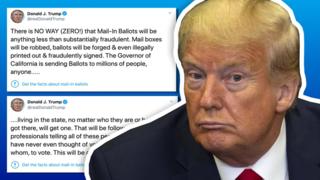
The long-running dispute between Mr Trump and social media companies flared up again on Tuesday, when two of his posts were given a fact-check label by Twitter for the first time.
He had tweeted, without providing evidence: "There is no way (zero) that mail-in ballots will be anything less than substantially fraudulent."
Twitter added a warning label to the post and linked to a page describing the claims as "unsubstantiated".
Then on Wednesday, Mr Trump threatened to "strongly regulate" social-media platforms.
He tweeted to his more than 80 million followers that Republicans felt the platforms "totally silence conservatives", and that he would not allow this to happen.
In an earlier tweet, he said Twitter was "completely stifling free speech".
Twitter's chief executive, Jack Dorsey, responded to criticism of the platform's fact-checking policies in a series of posts, saying: "We'll continue to point out incorrect or disputed information about elections globally."Report
Mr Trump wrote a similar post about mail-in ballots on Facebook on Tuesday, and no such warnings were applied.
Twitter has tightened its policies in recent years, as it faced criticism that its hands-off approach allowed fake accounts and misinformation to thrive.
Latest Stories
-
Retirement Is Not Disposal: Why Ghana Must Keep Using the Wisdom of Retired Teachers
13 minutes -
US applauds Ghana–US cooperation as 9 Ghanaians extradited over cybercrime
32 minutes -
The final mic: A nation pauses as Daddy Lumba takes his bow
46 minutes -
Amin Adam rejects ‘blind loyalty’ claims, says Northern support for Bawumia is based on competence
52 minutes -
Ghana Card becomes mandatory for insurance transactions from 2026
55 minutes -
December in GH: Beware of ‘I don’t have Cedis borgas’
56 minutes -
No $300 daily allowance: GAF explains real UN peacekeeping pay
57 minutes -
One dead, another in critical condition after wild bees’ attack
1 hour -
Michael Okyere Baafi hosts 2025 Christmas ‘Shop for Free’ initiative for elderly in New Juaben South
1 hour -
Opoku-Agyemang urges long-term investment to grow Africa’s film and creative economy
1 hour -
Analysing Bank of Ghana’s $10bn forex Intermediation in 2025
1 hour -
LA police investigate ‘apparent homicide’ at Rob Reiner’s home
1 hour -
Health Ministry secures GH¢22.8bn to upgrade facilities and expand workforce
1 hour -
ECOWAS denounces coup plots, moves to bolster West Africa’s security architecture
1 hour -
Brown University: ‘We made eye contact’: Ghanaian student describes alleged gunman bursting into lecture hall
1 hour