

Audio By Carbonatix
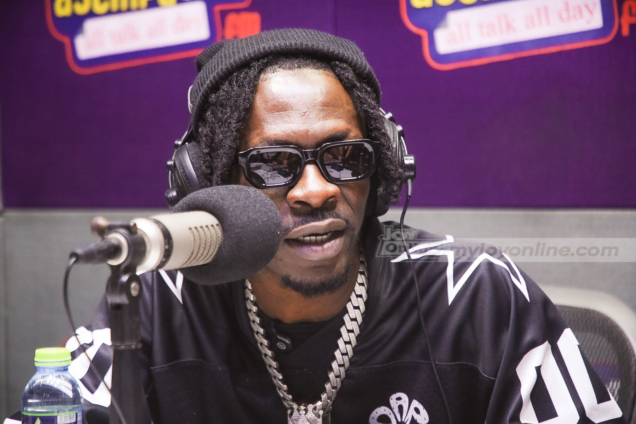
Ghanaian artiste Charles Nii Armah Mensah Jr., popularly known as Shatta Wale, has called for a balanced framework to tackle defamation, harassment and other forms of abuse on social media while protecting freedom of expression.
In an open letter to President John Dramani Mahama dated September 28, Shatta Wale said Ghana's response to harmful online content should be guided by clearly defined laws, due process and independent judicial oversight.
His proposal comes after President Mahama called for a national stakeholder dialogue on how Ghana should regulate TikTok and other new media platforms.
Speaking at a town hall meeting with Ghanaians in New York on September 25, President Mahama said the growing use of TikTok and other platforms had created challenges around misinformation, insults and information integrity.
He urged the Ghana Journalists Association (GJA) and the Media Foundation for West Africa (MFWA) to bring relevant stakeholders together to determine how new media should be regulated and whether the police should be involved.
In his letter, Shatta Wale said his position was informed partly by his experience as a public figure who had been subjected to what he described as unverified allegations and public ridicule.
He argued that the problem did not begin with social media, but evolved from sections of entertainment commentary and later spread to online comment sections before being amplified by platforms that allow anyone with a mobile phone to broadcast instantly.
According to him, the consequences now extend beyond celebrities, with traditional leaders, businesspeople, journalists, public officials and ordinary citizens all exposed to online abuse.
He stressed that freedom of speech and freedom of the media, guaranteed by Ghana's 1992 Constitution, must remain protected.
However, he said those freedoms should not be interpreted as a licence to threaten, harass or knowingly spread damaging falsehoods.
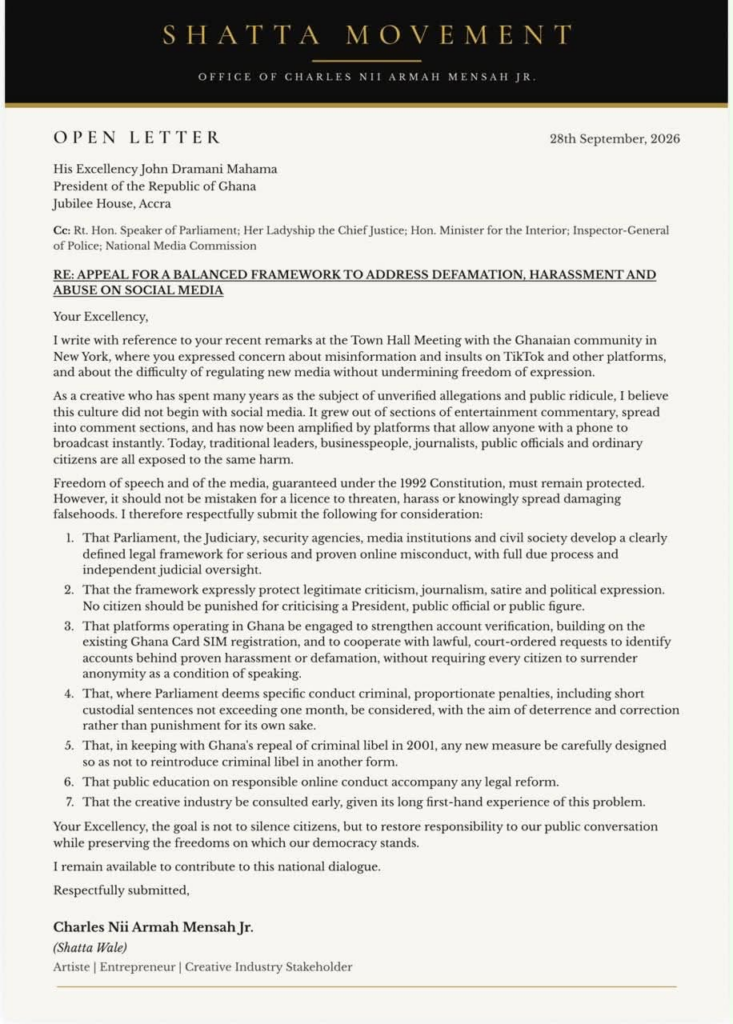
Shatta Wale therefore proposed that Parliament, the Judiciary, security agencies, media institutions and civil society collaborate to establish a clearly defined legal framework for serious and proven online misconduct.
He said any such framework should provide full due process and independent judicial oversight.
He also called for explicit protection for legitimate criticism, journalism, satire and political expression, stressing that citizens should not be punished simply for criticising a President, public official or public figure.
Another key proposal is for social media platforms operating in Ghana to strengthen account verification.
Shatta Wale suggested that the process could build on the existing Ghana Card and SIM registration system, while platforms should cooperate with lawful, court-ordered requests to identify accounts behind proven cases of harassment or defamation.
At the same time, he cautioned against making the surrender of anonymity a blanket requirement for participating in public discourse.
His proposal seeks to distinguish between legitimate anonymous expression and cases where anonymity is allegedly used to facilitate proven abuse or unlawful conduct.
Shatta Wale further proposed that where Parliament determines that particular online conduct should be criminalised, penalties should be proportionate.
He suggested that short custodial sentences of not more than one month could be considered for specific offences, with the stated purpose of deterrence and correction rather than punishment for its own sake.
He also urged caution in drafting any new legislation to ensure that it does not effectively recreate criminal libel.
Ghana repealed its criminal libel and seditious laws in 2001. The Criminal Code records that the relevant chapter on criminal libel was repealed by the Criminal Code (Repeal of Criminal Libel and Seditious Laws) (Amendment) Act, 2001 (Act 602).
Beyond legislation, Shatta Wale called for public education on responsible online conduct to form part of any reform.
He also urged the government and other stakeholders to consult the creative industry early in the process, citing the sector's extensive first-hand experience with public commentary, entertainment reporting and social media.
His proposals come against the backdrop of President Mahama's call for a collective approach to determining the boundaries of online expression.
The President has said he does not object to being insulted personally, but has questioned how Ghana should deal with online content involving misinformation, threats and other potentially harmful conduct. He has also expressed concern about arrests reportedly linked to insults directed at him, saying he was not aware of many such arrests and that the reasons given for some of them concerned him.
President Mahama has consequently called for stakeholders to determine whether the police should have a role in regulating new media and, more broadly, how Ghana can address information integrity without undermining free expression.
Shatta Wale said his proposed framework should ultimately seek to balance accountability with constitutional freedoms, rather than suppress public criticism.
“The goal is not to silence citizens, but to restore responsibility to our public conversation while preserving the freedoms on which our democracy stands.”
He said he remained available to contribute to the national dialogue on the future of social media regulation in Ghana.
Latest Stories
-
Bond market: Turnover declined by 28% to GH¢1.56bn
16 minutes -
Volta Region National Public Speaking contest advances drug prevention conversation
21 minutes -
New health training facility at Ampoma-Jema to address admission shortfalls, but Minister flags missing amenities
46 minutes -
Black Challenge unveiled with sights set on Amputee World Cup glory
1 hour -
Pay striking teachers before expressway spending, Dr Kingsley Agyemang tells government
2 hours -
Customs intercepts assault rifle, two pistols and 610 rounds of ammunition at Tema Port
2 hours -
PKO boxers secure wins at Odwira Festival
2 hours -
South Tongu Records Rise in Teenage Pregnancy
3 hours -
Cabinet threw out US health compact faster than anything I’ve seen – Mahama
3 hours -
MoFA urges Finance Ministry to reverse World Bank food programme withdrawal over GH¢643m commitments
3 hours -
NAGRAT demands signed timelines before calling off strike
3 hours -
National Investment Quiz: West Africa SHS, St. Louis SHS advance to semi-finals
3 hours -
Shatta Wale appeals to Mahama for balanced framework to tackle social media abuse without stifling free speech
3 hours -
Education Ministry urges data-driven talks to resolve teacher impasse
3 hours -
‘What we wanted was money to buy medications’ – Dr Nawaane on US health support
3 hours