

Audio By Carbonatix
Ghana’s Extractive Sector Multi-Stakeholder Group (MSG) has urged Parliament to summon State agencies over delays in disbursing mineral royalties to mining host communities.
The Group said the delays were stalling development projects, disrupting local planning and undermining the objectives of the Minerals Development Fund Act.
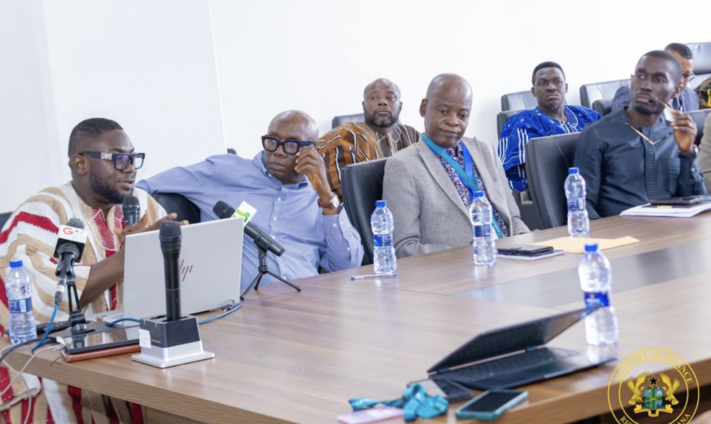
Dr Emmanuel Steve Asare Manteaw, a member of the MSG, made the call at a media engagement to disseminate the findings of the 2023 Ghana Extractive Industries Transparency Initiative (GHEITI) Report in Accra.
He attributed the persistent delays to weak oversight, saying Parliament should ensure compliance with the Minerals Development Fund Act, 2016 (Act 912), by holding State institutions accountable for the timely release of approved funds.
“A lot of development projects in some of these beneficiary communities have come to a standstill, and the uncertainty over the timing of disbursements makes it difficult for communities to plan development activities with any confidence.
“What is more worrying is the role of Parliament in all this because they passed the law mandating that certain percentages of mineral royalties be disbursed to mining host communities,”Dr Manteaw said.
He said Parliament should ensure that information on delayed payments, including the institutions responsible and the amounts outstanding, was made public to strengthen
transparency and accountability.
In a speech read on his behalf, Mr Patrick Nomo, Co-Chair of the GHEITI Multi-Stakeholder Group and Chief Director at the Ministry of Finance, said reforms to the mineral royalty regime had improved the management of extractive revenues.
He said GHEITI advocacy had contributed to reforms, including changes to the mineral royalty regime and the institutionalisation of subnational royalty transfers through the Minerals Development Fund to enable mining communities to benefit more directly from mineral resources.
Mr Nomo, however, said revenue leakages and weak inter-institutional coordination continued to constrain the sector’s contribution to national and local development.
He called for stronger institutional collaboration and improved data management to enhance transparency and ensure that resource revenues translated into tangible benefits for mining communities.
Mr Nomo reaffirmed the Government’s commitment to using evidence generated through GHEITI to inform policy reforms and strengthen accountability in the extractive sector.
Under the Minerals Development Fund Act, mineral royalties are distributed through a statutory formula, with district assemblies receiving 55 per cent of the allocation to local government, mining-affected communities 25 per cent and traditional councils 20 per cent.
Latest Stories
-
Trump hid in catering truck in secret plane swap over Iran threat, reports say
11 minutes -
Inside the Secret Service ‘shell game’ to hide US presidents in plain sight
13 minutes -
GEA seeks Gender Ministry’s support for Female Future Programme
24 minutes -
Driver beaten to death over misunderstanding at Gomoa Achiase
34 minutes -
Bagre Dam spillage: 68 communities in Northern region alerted as Burkina Faso monitors water levels
35 minutes -
ECG announces power outages in Central, Eastern and Western Regions on Thursday
38 minutes -
THE LAW 101: Tempus Non Currit – Why the sacred silence of the Legal Vacation protects justice (Part I)
1 hour -
God does not take campaign instructions
2 hours -
Government moves to address rising accommodation costs at KNUST
2 hours -
Cristiano Ronaldo marries longtime love Georgina Rodríguez in Portugal
2 hours -
Political parties, judiciary must reform themselves to protect Africa’s democracy – Asiedu Nketia
2 hours -
Luv FM High School Debate: T.I AMASS advances as IBASS makes impressive debut
2 hours -
Greater Accra Business Merit Awards honours SIM Group of Companies
2 hours -
Cyberbullying : When social media becomes a tool for public humiliation
2 hours -
Awerco Construction hands over 130-bed Weija Paediatric Hospital to Health Ministry
2 hours