

Audio By Carbonatix
A patient arriving at a hospital may expect clean water, a usable toilet, and somewhere for health workers to wash their hands. But across parts of West Africa, many health facilities still fall short of these basic standards, according to a new assessment by the World Health Organization (WHO) and UNICEF.
The gaps are particularly stark when it comes to sanitation. In Guinea-Bissau, only 7% of health care facilities met the basic sanitation standard in 2025. The figure was 11% in Burkina Faso, 12% in Mali, and 16% in Ghana. Nigeria recorded 29%, while Senegal stood at 35%.
The findings are contained in Progress on Water, Sanitation, Hygiene, Environmental Cleaning and Waste Management in Health Care Facilities 2015–2025, produced by the WHO/UNICEF Joint Monitoring Programme.
They reveal a problem that goes beyond whether a hospital or clinic simply has a toilet.
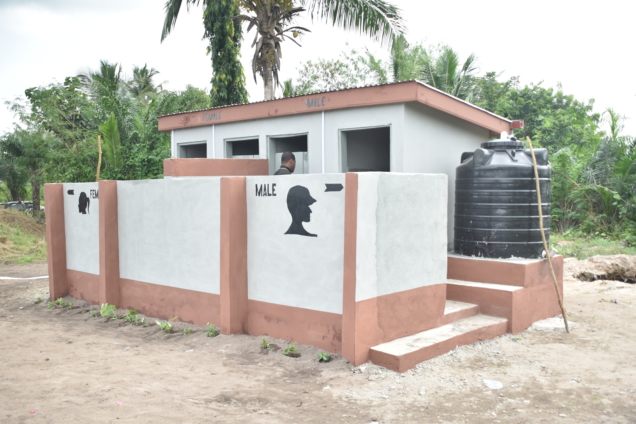
To meet the basic sanitation standard, a health facility needs improved and usable toilets. There must be a toilet for staff, separate facilities for men and women with provision for menstrual hygiene, and a toilet that can be used by people with limited mobility.
The report says menstrual hygiene facilities and access for people with limited mobility were often among the factors preventing health facilities from meeting the standard.
For patients, that can make something as ordinary as using a toilet while receiving medical care a question of privacy, accessibility, and dignity.
Ghana below the regional level
In Ghana, only 16% of its health facilities met the basic sanitation standard in 2025. That means roughly five in every six fell short of the full standard. The figure is also below the 23% recorded for sub-Saharan Africa and well below the 40% global level.
But Ghana is not the lowest among the West African countries for which estimates are available.
Basic sanitation coverage was 7% in Guinea-Bissau, 11% in Burkina Faso and 12% in Mali. Côte d'Ivoire recorded 21%, while Nigeria and Senegal performed better at 29% and 35% respectively.
The differences are substantial, but even some of the better-performing countries remain far from universal coverage.
Some facilities still have no water
Sanitation is only part of the problem. The assessment also found health facilities operating without basic water services in several West African countries.
In Ghana, 65% of health facilities had basic water services in 2025, meaning water from an improved source was available on the premises. Senegal recorded 75%, while Sierra Leone stood at 64%.
But the report identifies several West African countries where at least one in 10 health facilities had no water service. They include Liberia, Nigeria, Côte d'Ivoire, Sierra Leone and Guinea-Bissau.
The situation was particularly difficult in Guinea, where more than half of health facilities had no water service.
Water in a health facility is needed for handwashing, cleaning, sanitation and other routine infection-prevention measures.
There are also gaps in something health workers and patients are routinely told is one of the simplest ways to prevent infection, washing their hands.
WHO and UNICEF classify a health facility as having a basic hygiene service when functional hand-hygiene facilities are available at points of care, with water and soap available at toilets.
In Ghana, 54% of health facilities met that standard. But the report identifies Nigeria, Niger, and Côte d'Ivoire among countries where at least one in 10 health facilities had no hygiene service, meaning hand-hygiene facilities were missing both at points of care and near toilets.
Across sub-Saharan Africa, only 34% of health facilities met the basic hygiene standard in 2025.
What happens to medical waste?
Another problem begins after treatment has been given. Hospitals and clinics generate used needles, contaminated materials, and other potentially infectious waste that must be separated, treated, and disposed of safely.
Across sub-Saharan Africa, only 24% of health facilities met the basic waste-management standard in 2025.
Several West African countries appear among those with low coverage, including Niger, Nigeria, Guinea-Bissau, Côte d'Ivoire, Burkina Faso, Senegal, and Ghana. In Ghana, the figure was 27%, a little more than one in four facilities.
The report also names Burkina Faso, Ghana, Niger and Nigeria among countries where more recent surveys produced lower estimates of waste-management coverage.
WHO and UNICEF caution that this does not necessarily mean conditions have become worse. Better data collection may now be revealing gaps that previous monitoring systems did not fully capture.
Beyond the numbers
The report does not provide a single figure for West Africa as a region, so the country estimates cannot simply be combined into a regional average. But taken together, they show how uneven the provision of basic services remains across health facilities in the region.
A country may perform relatively well on water but poorly on sanitation. Another may have handwashing facilities in most hospitals, but struggle with the safe disposal of medical waste.
And behind each percentage is an everyday issue for people seeking or providing health care: Is there running water? Is there a usable toilet? Can a patient with limited mobility use it? Can a health worker wash their hands where care is being provided? And can a used needle be disposed of safely?
Globally, 85% of health facilities had basic water services in 2025. But coverage fell to 72% for hygiene, 71% for waste management, and just 40% for sanitation.
For many West African health facilities captured in the WHO/UNICEF assessment, the distance from those global levels remains substantial.
Latest Stories
-
UPSA challenges students to turn classroom knowledge into real-world solutions
16 minutes -
Ghana urged to build capacity to maximise China’s zero-tariff policy
29 minutes -
NSMQ 2026: TEMASCO returns to one-eighth stage after last year’s heartbreaking loss
34 minutes -
Photos: Republic Bank JoyNews Habitat Fair Day 1 draws visitors as they engage exhibitors
35 minutes -
NSMQ 2026: AHEMAA silence AHENEMMA – Kumasi Girls storm into one-eighth stage as OKESS stumble
40 minutes -
Profs4Agyarko hail newly elected NPP regional executives
41 minutes -
Bono Police arrest suspect over alleged GH¢1.1m fake gold deal in Berekum
45 minutes -
‘I will fight for NPP with a clear mind’ – Afenyo-Markin
45 minutes -
NSMQ 2026: OPASS seize control from Mim SHS, Oyoko Methodist to advance to one-eighth stage
46 minutes -
Dorimon E-Block project nears completion after decade-long stall
1 hour -
‘Eat humble pie’ – Afenyo-Markin challenges NDC over GH¢22bn GoldBod losses
1 hour -
Ghana secures €163m debt restructuring deal with Belgium – Ato Forson
1 hour -
FIFA lifts player registration ban on Karela United FC
1 hour -
New Dansoman drainage to measure 2 metres high and 5 metres wide – Engineer Tsegah
1 hour -
Burnley, Wrexham competing for Crystal Palace winger Jesurun Rak-Sakyi
1 hour