

Audio By Carbonatix
Bank of Ghana (BoG) Governor, Dr Johnson Asiama, says Middle East tensions and uncertainty in the global economy will be key factors in the central bank’s November policy rate decision.
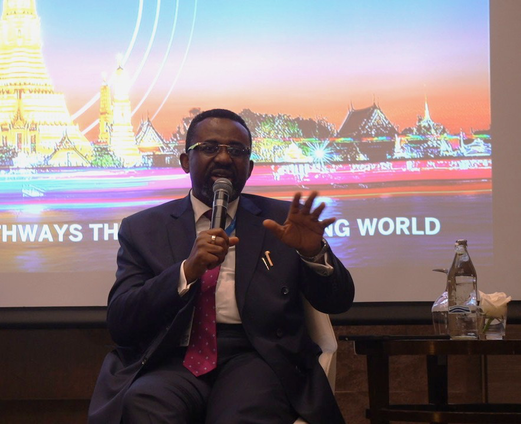
Speaking at an investor engagement in Bangkok, Thailand, Dr Asiama said the risks confronting Ghana’s economy were largely external, citing movements in the US dollar and gold prices, tighter financing conditions, and the anticipated effects of El Niño.
He was addressing institutional investors, brokers and fund managers at an event organised by Standard Bank at the Conrad Hotel, on the sidelines of the annual IMF/World Bank meetings.
Dr Asiama said external pressures had influenced the Monetary Policy Committee’s unanimous decision in September to hold the policy rate at 14 per cent. Members cited external risks and concerns about rising inflation among the reasons for maintaining the rate.
With uncertainty persisting, he said the central bank was closely monitoring international developments to assess their implications for Ghana’s economy and the committee’s next decision.
The Governor also pointed to the US midterm elections in November as a development whose potential impact required attention.
He told investors that, following a recent meeting, he had asked his staff to assess what could happen after the elections.
Turning to the banking sector, Dr Asiama assured investors that the industry remained sound, with asset quality continuing to improve.
He attributed the progress to ongoing regulatory measures by the central bank, including recent liquidity directives and steps aimed at reducing the non-performing loan ratio by year-end.
Responding to a question about the Bank of Ghana’s 2025 financial results, Dr Asiama said the losses should be understood in the context of the cost of stabilising the economy.
He highlighted the cost of open market operations, which he said had helped bring inflation down to its current level.
The Governor described the loss as a one-off and said he did not expect a repeat this year. He projected an improved financial position in 2027, with the possibility that the central bank could record a surplus in 2032.
Dr Asiama also disclosed that the government had agreed to recapitalise the Bank of Ghana by issuing bonds.
He said an agreement on the recapitalisation could be signed next month.
Latest Stories
-
Services drive 7.4% expansion in Ghana’s economic activity
1 minute -
‘I don’t make music for awards, I make it to connect people’ – Rocky Dawuni
13 minutes -
Farmer jailed for three months over assault on wife in viral video
19 minutes -
Police arrest eight in Okaishie operation targeting illicit drugs and medicines
22 minutes -
David Agyemang Yeboah: Marriage is not the problem; your approach is
25 minutes -
Lawyer sues Standards Authority over used-vehicle import restrictions
27 minutes -
Ukraine to restart strikes on Russian oil refineries, Zelensky says
27 minutes -
CIMG awards drive competition among Ghanaian businesses
33 minutes -
NSA regional director Emmanuel Reagan files nomination to contest NDC Ashanti Regional Organiser position
38 minutes -
Obuasi SHTS: Number of students alleging sexual abuse rises to 16
43 minutes -
Ghana’s economy grows by 7.4% in July 2026
54 minutes -
NDC member challenges Dennis Yeboah Twumasi’s eligibility for Bono Regional Secretary elections
1 hour -
Popular Nigerian gospel singer Toluwanisings dies
1 hour -
Spio-Garbrah proposes debt swaps to fund reparative justice in Africa and Caribbean
1 hour -
Alban Bagbin calls for governance reforms and coordinated action to address Africa’s debt crisis
1 hour