

Audio By Carbonatix
The Majority in Parliament has blamed what it describes as years of inadequate resourcing of the Narcotics Control Commission (NACOC) for Ghana’s current challenges in tackling narcotics trafficking.
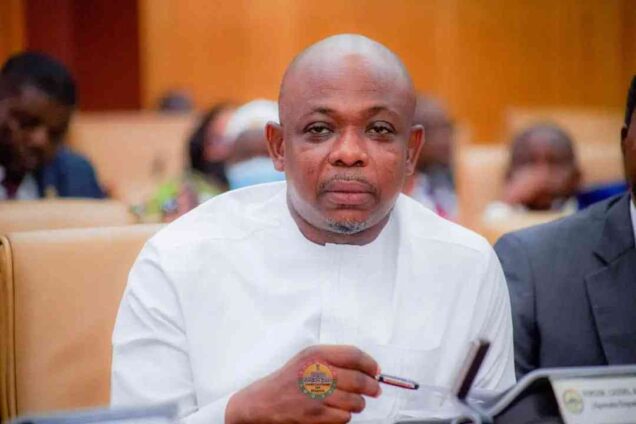
Majority Leader and Chairman of Parliament’s Defence and Interior Committee, James Agalga, accused the Akufo-Addo administration of failing to adequately equip and staff the agency to deal with an increasingly sophisticated drug-trafficking industry.
Speaking to journalists in Parliament, Mr Agalga said the public needed to understand the state of NACOC before 2025 in order to assess the measures being taken by the current administration.
“The public must be informed of the extent of institutional neglect that preceded 2025 to fully value the transformation that is now taking place and hold this government to the standard it has set itself. The state of the situation prior to 2025 — an institution left to fail,” he said.
According to him, NACOC had been under-resourced, understaffed and insufficiently institutionalised to effectively protect the country against narcotics trafficking.
“This was not a commandment which was not carried out. This was a need that was not met and resources were not available to do so,” he said.
Mr Agalga also pointed to a 2018 decision that removed NACOC from routine joint physical inspections of containers at the Tema Port, describing the change as having created a blind spot in Ghana’s port security system.
“This country made a decision in 2018 whose impact we are still facing. NACOB was no longer to be subject to mandatory joint inspection at the Tema port,” he said.
The 2018 reforms reduced the number of agencies involved in routine physical container inspections at the ports. Former Defence Minister Dominic Nitiwul has, however, disputed descriptions that NACOC was removed from the ports.
Mr Nitiwul said NACOC officers remained at the port but were stopped from participating in routine physical inspections. He explained that the reforms were intended to reduce delays and bureaucracy associated with multiple agencies inspecting the same containers.
The competing accounts have become part of the wider debate over whether the 2018 changes affected Ghana’s ability to detect narcotics concealed in export consignments.
There is also disagreement over whether the decision can be directly linked to the recent increase in high-profile narcotics seizures. A former government official, Kofi Brako-Powers, has argued that there is no data yet establishing that the 2018 policy decision caused the recent spike in drug trafficking.
The Majority’s comments come amid heightened scrutiny following several major narcotics seizures involving Ghana-linked consignments.
The latest case involves nearly 3.9 tonnes of cocaine intercepted by French authorities at the Port of Dunkirk in a container that had departed Ghana.
The seizure has triggered investigations in Ghana, with President John Dramani Mahama directing security agencies to develop a roadmap for preventing narcotics trafficking through the country’s borders.
As part of the measures announced by the government, NACOC is being restored to the joint container inspection process at Ghana’s ports, while security and regulatory agencies have been directed to harmonise their operations.
The development comes ahead of Parliament’s scheduled sitting on September 29 following a petition by 48 MPs seeking an extraordinary sitting to scrutinise major narcotics seizures linked to Ghana.
The Speaker’s notice recalling Parliament does not, however, specify the business to be considered at the sitting.
The Majority’s position on NACOC’s resourcing and the 2018 port reforms is therefore likely to form part of the wider political debate over responsibility for Ghana’s current narcotics-control challenges.
Latest Stories
-
Mahama warns against weaponising identity to fuel exclusion and conflict
2 minutes -
Mahama calls for global equality, says “no race is superior, no nation is inferior”
2 minutes -
24-Hour Economy will transform Ghana into industrial hub – Mahama
3 minutes -
Mahama highlights MahamaCare, Free Primary Health Care at UN
5 minutes -
Mahama says Big Push will bridge Ghana’s rural-urban infrastructure gap
6 minutes -
MPC maintains policy rate at 14% for third consecutive meeting amid inflation risks
10 minutes -
Freedom of any nation is insecure unless linked to freedom of all humanity – Mahama
10 minutes -
Mahama backs stronger global action to lift Cuba embargo
11 minutes -
Full Text: President Mahama’s speech at 81st Session of the United Nations General Assembly
14 minutes -
Climate finance must come as grants, not loans – Mahama
15 minutes -
Mahama demands climate finance as he recounts Ghana’s deadly June floods
17 minutes -
Mahama outlines Ghana’s priorities ahead of 2027 AU chairmanship
18 minutes -
Mahama urges world leaders to build bridges instead of walls
20 minutes -
Mahama highlights Ghana’s economic recovery, healthcare expansion at UN
20 minutes -
Mahama: Africa will no longer export raw minerals without value addition
29 minutes