

Audio By Carbonatix
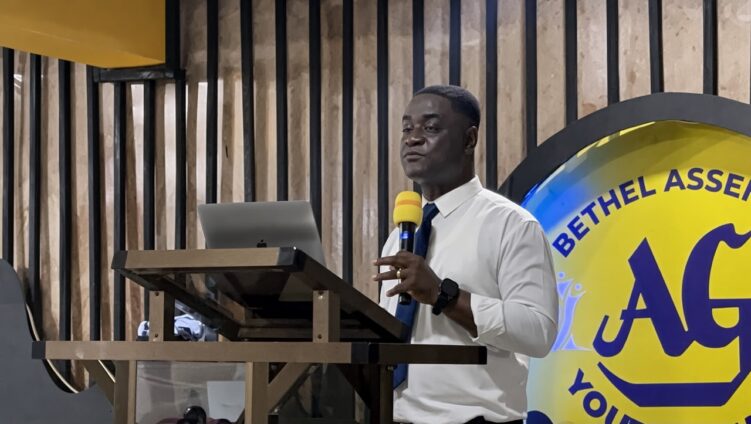
The Artificial Intelligence Coordinator at the Kwame Nkrumah University of Science and Technology (KNUST), Professor Eric Appau Asante, has urged churches to embrace emerging technologies while ensuring that their use remains grounded in Christian values.
He said the rapid development of artificial intelligence and other digital technologies presents opportunities for churches to expand their reach, support sermon preparation and complement ministerial activities.
Professor Asante was speaking during the Christian Home Week organised by the KNUST Local Council of Churches at the Assemblies of God International in Ayigya.
He addressed the theme “The Christian and Emerging Technologies: Their Responsible Uses.”
According to him, technology can help churches serve emerging generations and ensure that people who increasingly live and interact in digital spaces are not left behind.
He, however, stressed that technological convenience must not come at the expense of human dignity, privacy, truth and Christian values.
He said AI tools could help organise ideas, support learning activities and complement ministry, but their use must be guided by ethical and spiritual discernment.

Professor Asante cautioned Christians against assuming that digital content is authentic simply because they have seen a photograph, heard a voice or watched a video.
He said advances in AI now make it possible to generate photographs, replace faces, clone voices and create videos portraying people saying or doing things that never happened.
“A photograph can be generated. A face can be replaced. A voice can be cloned. A video can be manufactured. A sermon can be generated. A person can be made to appear to have said or done something that never happened.”
He said the development means Christians must become more deliberate about verifying information before believing or sharing it.
“We can no longer treat ‘I saw the video’ or ‘I heard the voice’ as automatic proof. Verification has become part of digital maturity,” he said.
Professor Asante said emerging technologies could also support church administration and theological education.
He identified data analytics, digital dashboards, cloud systems, digital meeting platforms, speech-to-text tools, electronic voting and digital signatures as technologies that could improve planning, administration, elections and institutional accountability.
In preaching, Bible teaching and theological education, he said digital Bible software, theological databases, electronic libraries, virtual classrooms and AI tools could assist pastors and students with activities such as comparing Bible translations, researching biblical geography and organising ideas.
He, however, cautioned that technology should support leadership rather than replace prayer, discernment, human judgement and responsibility.
According to Professor Asante, churches can also use social media, podcasts, translation systems, mobile applications, chatbots, digital advertising and geospatial technologies to extend evangelism and missionary activities beyond geographical boundaries.
He said responsible use of these tools could enable churches to reach people who may otherwise remain outside traditional forms of ministry.
Professor Asante also urged churches to exercise restraint when recording and publishing events, particularly where individuals may be emotionally vulnerable.
He cited funerals, weddings, altar calls, counselling sessions and moments of prayer as situations involving sensitive personal experiences that should not automatically become online content.
He stressed that the ability to record an event does not necessarily mean there is permission to publish it.
“Privacy is pastoral care. Data is not merely an object; behind the data is a person,” he said.
He urged church media teams to consider whether they have obtained consent, whether a family has publicly announced information and whether publishing a particular image or video serves a legitimate purpose.
Professor Asante said the broader principle should be to ensure that technology extends ministry without replacing humanity, communicates truth without manufacturing reality, expands access without deepening exclusion and improves stewardship without removing human responsibility.
He ultimately urged Christians to ensure that the adoption of emerging technologies remains anchored in truth, wisdom, love, responsibility, and the glory of God.
Latest Stories
-
GRAY Network’s Menstrual Health project transforms education in Central and South Tongu
9 minutes -
Green finance goes beyond banks and big corporations to driving climate and environmental solutions – Nanabanyin Addo-Brown
12 minutes -
The journey is short
16 minutes -
Teacher unions give government September 24 deadline to resolve promotion arrears
17 minutes -
Restoring BDC confidence helped turn around TOR – MD
28 minutes -
Chipper Cash launches bank-backed virtual accounts through collaboration with Universal Merchant Bank in Ghana
28 minutes -
I’m beginning to suspect NPP members may be involved in drug trafficking – Mustapha Gbande
31 minutes -
How hasty reading and inattention to complex texts may affect Ghanaian learners’ comprehension
35 minutes -
Public transport fares to increase by 8% from September 26
35 minutes -
How a $125m plant meant to fix Teshie-Nungua’s water crisis became a $235m judgment debt
36 minutes -
NPP calls for parliamentary inquiry into cocaine trafficking concerns
36 minutes -
Appiatse redevelopment enters final phase with 69 new housing units
37 minutes -
Ahafo Ano South West DCE was tipped to win parliamentary for NDC seat in 2028 – Ashanti Region NDC Chairman
43 minutes -
UniMAC Dean urges freshers to build strong personal brands, networks
46 minutes -
Meet Larry Prince: Maamobi-born artiste turning street experiences into music
47 minutes