

Audio By Carbonatix
An Indian high court has upheld a ban on the wearing of hijabs or headscarves in educational institutes in Karnataka state, weeks after religious clashes erupted over the right to wear the Islamic garment in schools.
The state's top court on Tuesday ruled that the hijab was not an "essential religious practice in Islamic faith" and dismissed a set of petitions filed by Muslim students denied entry to classrooms in multiple schools and colleges across the state.
The court also ruled that requirement for students to comply with school uniforms is a "reasonable restriction, constitutionally permissible and which the students cannot object to."
Karnataka Chief Minister Basavaraj Bommai appealed for calm after the ruling, which authorities feared could reignite religious protests.
"I request everybody to follow the high court order and maintain peace and order," Bommai told reporters Tuesday. "And allow the children to do their education as usual."
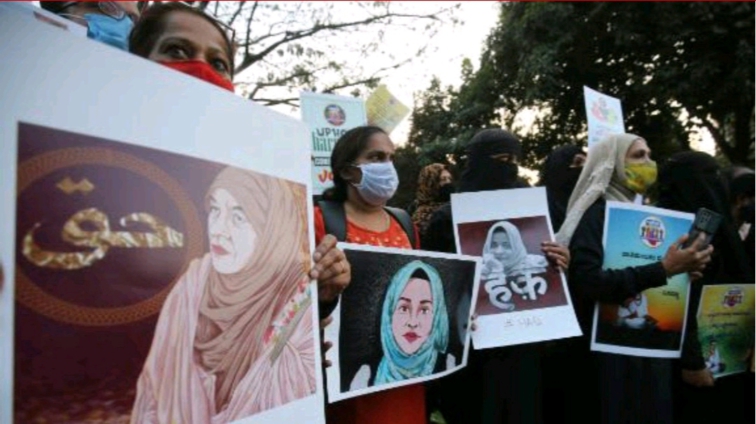
The controversy erupted after students staged a small protest in January demanding they be allowed inside the classroom while wearing the Islamic garments.
Their demonstration prompted rival protests from right-wing Hindus carrying saffron scarves -- a color widely associated with Hinduism -- - and chanting a religious Hindu slogan in support of Indian Prime Minister Narendra Modi's ruling Bharatiya Janata Party (BJP).
The dispute was seen as a symbol of deepening religious tensions in the state, where authorities ordered the closure of all high schools and colleges for several days to discourage protests in early February. Rallies in the state's capital, Bengaluru, were also banned outside educational institutions for two weeks.
Scores of women from other Indian cities, including capital Delhi, Hyderabad and Kolkata, also took to the streets in support of the Muslim girls.
State authorities had supported the hijab ban, citing the state's mandate on religious attire.
But experts and activists say the hijab row runs deeper than a dress code, claiming it's indicative of a wider crackdown on India's minority Muslim population since Modi's BJP came to power almost eight years ago.
Karnataka -- where just 13% of the population is Muslim -- is governed by the BJP, and the state has already passed legislation critics say favors Hindus.
Lawyer Mohammed Tahir, who represented one group of petitioners in court, told CNN last month that Karnataka was a "hotbed" of Hindutva ideology, supported by many right-wing groups, which seeks to make India the land of the Hindus.
"We welcome the verdict. However, we are yet to ascertain the reasoning," one of the girls' lawyers, Shatabish Shivanna, told CNN of Tuesday's judgment.
"We will talk to the petitioners and then we will look out to what legal recourse we want to take."
Latest Stories
-
GPL 2025/26:Samuel Tetteh brace fires Nations FC past Basake Holy Stars
8 minutes -
Ghana’s oil trade position close to net neutral in near term – Fitch
30 minutes -
IMANI Africa President urges greater awareness and support for Parkinson’s Disease patients
41 minutes -
T-bills: Government records 29% undersubscription; interest rates continue to surge
43 minutes -
Perceptions of Judicial partisanship ‘unfortunate’ – Justice Adjei-Frimpong urges greater public engagement to build trust
46 minutes -
Ghana to honour Christina Hammock Koch for historic Artemis II mission
2 hours -
Supreme Court appointments require more than 15 years’ experience – Justice Adjei-Frimpong
2 hours -
Fire destroys 3-bedroom house at Bogyawe
2 hours -
Why the Supreme Court is a “policy court” – Justice Richard Adjei-Frimpong breaks it down
2 hours -
Playback: The Law discussed Supreme Court @150
4 hours -
MTN Momo staff walk to promote wellness and fitness
4 hours -
Assafuah: Sedina Attionu’s return from Nevada will test government’s commitment to accountability
4 hours -
How GRA’s Modified Taxation Scheme is boosting revenue compliance & SMEs competitiveness
4 hours -
Stonebwoy Can Do It: A call to unite behind 2026 BHIM Fest
5 hours -
World Shea Expo returns to Tamale for 2026 edition
5 hours