

Audio By Carbonatix
International donor funding for HIV programmes in low- and middle-income countries fell by US$2.1 billion in 2025, the steepest annual decline since global HIV financing began.
The 25 per cent reduction cut donor government disbursements to US$6.2 billion from US$8.3 billion in 2024, the lowest level since 2007, raising concerns about the continuity of HIV prevention and treatment services.
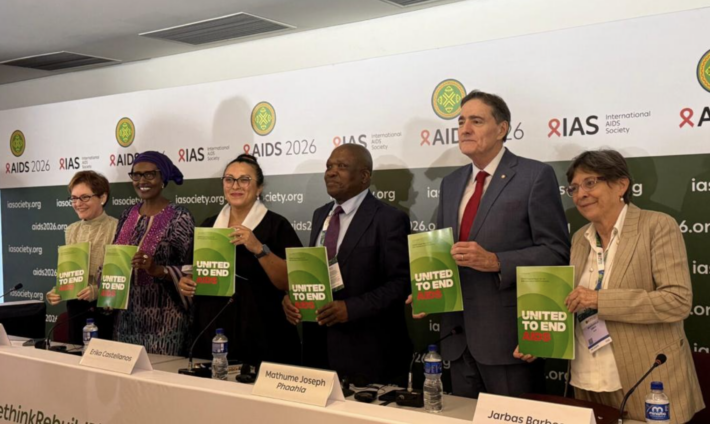
The findings are contained in the joint report, United to End AIDS, by the Joint United Nations Programme on HIV/AIDS (UNAIDS) and KFF, an independent health policy research, polling and news organisation, launched at the 26th International AIDS Conference in Rio de Janeiro, Brazil.
The report attributed the decline largely to reduced disbursements from the United States, the world’s largest HIV donor, and warned that the funding cuts had disrupted community-led HIV prevention, testing, treatment and support services in many countries.
It said nations that depended heavily on external financing were already scaling back prevention programmes, reducing community services and limiting access to lifesaving treatment.
Launching the report, Ms Winnie Byanyima, Executive Director of UNAIDS, said the global HIV response had entered an immediate funding crisis.
“Never has donor funding fallen so far, so fast,” she said.
Ms Byanyima said countries that relied on international assistance for nearly 60 per cent of their HIV programmes were already closing community organisations, scaling back prevention services, laying off health workers and limiting access to lifesaving treatment.
“When prevention disappears, infections rise. When treatment is interrupted, people die. We have seen this before. We know how the story ends if we fail to act,” she warned.
Despite the funding decline, the report said significant progress had been made in controlling the epidemic.
It said new HIV infections fell by 42 per cent between 2010 and 2025, from 2.1 million to 1.2 million, while AIDS-related deaths declined by 57 per cent to 570,000.
More than 32 million people were receiving antiretroviral therapy in 2025, the highest number recorded, while 87 per cent of pregnant women living with HIV received treatment to prevent mother-to-child transmission.
The report, however, warned that the world remained off course to end AIDS as a public health threat by 2030.
It estimated that 2025 recorded one million more new HIV infections and 400,000 more AIDS-related deaths than would have occurred had countries remained on track to achieve global targets.
Ms Byanyima said recent advances in long-acting HIV prevention medicines had made ending AIDS scientifically achievable but cautioned that equitable access remained essential.
“For the first time, ending AIDS is scientifically achievable, but innovation without access is not innovation; it is injustice,” she said.
She called for affordable pricing, voluntary licensing, expanded generic production, regional manufacturing and rapid integration of long-acting HIV prevention medicines into national HIV programmes.
Ms Erika Castellanos, Executive Director of the Global Action for Trans Equality (GATE) and a transgender woman living with HIV, said political decisions had become a major obstacle to ending AIDS.
“I have watched medicines transform HIV from a death sentence into a manageable condition, but I have also watched people die while those medicines existed. Science did not fail. Politics did,” she said.
Dr Joe Phaahla, South Africa’s Deputy Minister of Health, urged donor governments and development partners to support a gradual transition as countries increased domestic financing for HIV programmes.
Dr Mariangela Simão, Brazil’s Secretary for Health and Environmental Surveillance, said
governments required affordable HIV medicines to sustain universal access.
The report urged countries to increase domestic investment, strengthen national ownership of HIV programmes, integrate HIV services into broader health systems and expand equitable access to new HIV prevention technologies.
Latest Stories
-
South Africa dump site collapse kills 14 suspected illegal miners
50 minutes -
Thailand suspends new gun permits after mass shooting
59 minutes -
France bans unsolicited telemarketing calls
1 hour -
Anne Hathaway pokes fun at ‘fake baby bump’ theories
1 hour -
The Office actress Lucy Davis says she has ‘incurable’ cancer
1 hour -
Pogba expected to have Monaco contract terminated
2 hours -
Doku ‘not against’ journalist who criticised him at World Cup
2 hours -
Obuasi court remands 2 teachers over alleged attack on SHS headmaster
2 hours -
Mason jailed eight years for robbing pharmacist
2 hours -
Big Push probe: Presidential staffer challenges Fourth Estate’s report on Valerie Sawyerr committee
2 hours -
Since Gold Coast, national security has never faced an open trial – Atta Akyea
2 hours -
This is no case for junior lawyers – Atta Akyea explains why he must defend Adu-Boahene
3 hours -
Lebanon parliament votes to abolish death penalty
3 hours -
Ghana, Burkina Faso sign defence pact to secure cross-border trade corridors
3 hours -
The rise of AI in the classroom: Balancing technological innovation with critical thinking
3 hours