

Audio By Carbonatix
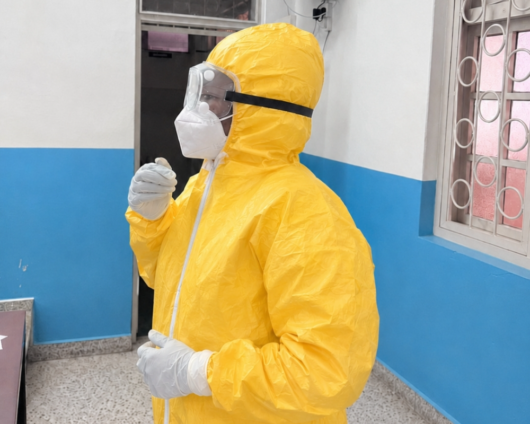
Patients have now been enrolled in the PARTNERS trial in the Democratic Republic of the Congo, the world's first real attempt to scientifically determine whether anything actually works against Bundibugyo virus disease.
It is a joint effort between the Institut National de Recherche Biomédicale in Kinshasa, the Institute of Tropical Medicine in Antwerp, and Oxford's Pandemic Sciences Institute, sponsored by the World Health Organization and run hand in hand with the DRC's Ministry of Public Health. Two treatments are being tested: the antibody MBP134 and the antiviral remdesivir, given alone and in combination, to see whether either can influence the odds of survival.
What sets PARTNERS apart is that none of this was built in a hurry. The protocols, the partnerships, the ethics approvals: all of it existed before this outbreak did. So when Bundibugyo virus turned up, the trial didn't need to be invented. It just needed to be switched on.
"We urgently need treatments that can help people affected by Bundibugyo virus disease," said Professor Amanda Rojek, PARTNERS' International Principal Investigator. "One of the key lessons from recent outbreaks is that research needs to happen alongside the response, not after it. This trial gives us the chance to generate answers in months, not years, while the outbreak is still happening, not once it's over."
Another side of the clinical trial: the part without a needle
Here's what doesn't make it into most coverage of a trial like this: a drug can be perfectly designed and still struggle because nobody trusted the people offering it.
Ghana's Kumasi Centre for Collaborative Research in Tropical Medicine (KCCR) at Kwame Nkrumah University of Science and Technology (KNUST), through its Global Health and Infectious Diseases Research group (GHID), leads Work Package 3 of PARTNERS: Patient and Public Involvement and Community Engagement. They will not be running trial sites in the DRC; rather working alongside the teams who are on the ground there, offering strategy, tools and technical support as they work out how families hear about the trial, how consent gets explained in a way people actually understand, how rumours get answered before they harden into fact, and how what communities say back gets folded into how the trial is actually run.
Prof. John Amuasi, who leads GHID at KCCR-KNUST and heads Work Package 3, put it plainly: "No treatment saves lives if the community it's meant for doesn't trust the people delivering it. Community engagement is not simply a small part of a trial like PARTNERS. Our role in Work Package 3 is to support the teams working directly with communities on the ground, so the people at the centre of this outbreak are informed and heard, not just enrolled."
Why this matters more than it sounds like it should
The toll from this outbreak is real and still climbing: hundreds diagnosed, many recovered, and lives lost. But numbers don't capture what an outbreak actually feels like from inside a village: the fear, the grief, and often, deep wariness of strangers showing up with unfamiliar treatments in the middle of a crisis.
Outbreaks have collapsed before, for lack of trust, although the science was good. Rumour fills any silence left by researchers who don't show up to explain themselves. And once broken, trust is brutally hard to rebuild mid-crisis, driving people away from care, from testing, from trials that might have saved them.
That's the exact gap community engagement work is built to close: relationships with leaders, clergy, survivor networks, and local health workers; conversations that run both ways instead of announcements handed down from above. Get that right, and a trial stops being something done to a community and becomes something built with it.
Professor Jean-Jacques Muyembe, Director of INRB made a version of this point himself, noting that folding the trial into everyday clinical care gives patients access to promising treatments now, while building the evidence base for the next outbreak, something only possible where trust already exists between researchers and the people they serve.
PARTNERS is funded through long-term support from Wellcome, the UK Foreign, Commonwealth & Development Office (FCDO), and the Medical Research Council (MRC), part of UK Research and Innovation (UKRI). Committed years before this outbreak began, that funding is what built the scientific collaborations, operational readiness, and research infrastructure that now allows new treatments to be evaluated so quickly.
Latest Stories
-
Government has improved sanitation in one-and-a-half years — Salaga South MP
2 hours -
Nkwanta North Assembly to appear before Parliament over DACF sanitation spending
2 hours -
Mourinho prints out ‘red card’ incidents after Real lose derby
3 hours -
Atletico beat 10-man Real in feisty Madrid derby
3 hours -
Twelve Tribes of Israel Ghana to mark 40 years with anniversary celebration
3 hours -
GPL 2026/27: Hearts held by Bechem as Kotoko, Samartex share spoils
4 hours -
My Story (Kwaku Antwi-Boasiako)
4 hours -
We expect growth rate to re-accelerate in second-half of 2026 – IC Insights
4 hours -
The ungodliness and unrighteousness underlying the National Cathedral mess!
4 hours -
T-bills auction: Government fails to achieve target; yield on 91-day-bill remains unchanged
4 hours -
It’s Ghana’s shame to denigrate Nkrumah when the whole world honours him as African of the Century – Asiedu Nketiah
4 hours -
No other nationalist can compare to Nkrumah – Asiedu Nketiah
4 hours -
Collateral Registry: Foreign banks accounted for GH¢19.9bn of secured credit in quarter 2, 2026
4 hours -
This government should expect scrutiny – Asiedu Nketiah
5 hours -
Two-year-old girl dies in domestic fire at Cantonments
6 hours