

Audio By Carbonatix
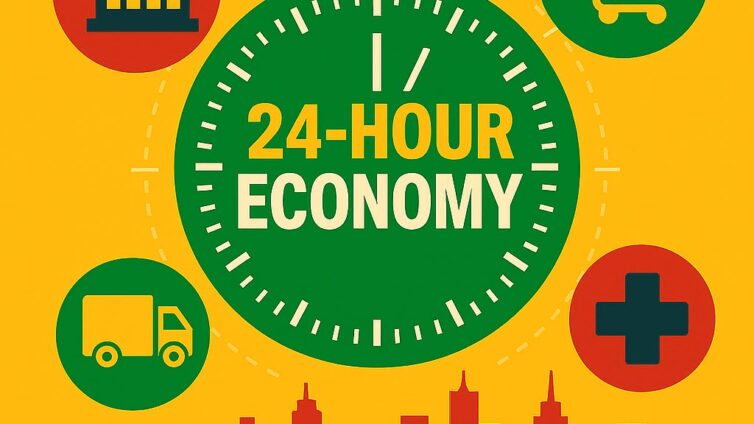
Ghana’s ambition to build a productive 24-Hour Economy could face a major financing constraint unless the country changes how it funds agriculture and industry, with private-sector players proposing a Value Chain Industries Bank (VCIB) to provide long-term capital from raw-material production through manufacturing to the final market.
The proposed private-sector-led development finance institution would target agriculture, manufacturing, fast-moving consumer goods (FMCGs) and export value chains, addressing what industry stakeholders see as a persistent mismatch between short-term financing and the longer investment periods required to build competitive industries.
Ghana cannot sustainably expand manufacturing, substitute imports and increase exports by financing factories while leaving the farms, suppliers, distributors and markets on which those factories depend underfunded.
President John Dramani Mahama’s 24-Hour Economy agenda seeks to expand production, employment and value addition. But operating factories for longer hours will require more raw materials, working capital, logistics, warehousing and market demand.
Familiar industry figures argue that financing must therefore follow the entire production chain rather than treat factories as isolated investments.
An agro-processing company, for example, may have to establish a factory while simultaneously developing thousands of acres of raw materials, building outgrower networks, establishing distribution and penetrating domestic and export markets.
These investments can take up to ten years to mature, yet some industrial projects have had to operate within financing periods of about six years, creating repayment pressure before their agricultural and commercial ecosystems reach sufficient scale.
VCIB would seek to address that mismatch by aligning the tenure of financing more closely with the gestation period of the industry being financed.
The experience of indigenous agro-processing companies such as Ekumfi Fruits & Juices highlights the challenge. A large processing facility cannot operate efficiently without adequate raw materials, and where financing builds factory capacity without simultaneously expanding farms and outgrower production, utilization can remain below installed capacity.
Low utilization raises unit costs, weakens competitiveness and puts pressure on cash flow and debt servicing.
The factory may have been financed, but the value chain was not.
Unlike another wholly state-owned development bank, VCIB would be substantially private-sector driven, bringing together manufacturers, agribusinesses, FMCGs, institutional investors and private capital, with government participating as a strategic partner and potentially a minority investor.
The model would seek to leverage productive assets already held by Ghanaian companies—including factories, machinery, warehouses, farms, plantations, inventories, receivables and distribution networks—to mobilize larger pools of long-term capital.
One of its proposed innovations is greater recognition of biological assets in agricultural financing.
Commercial cocoa, oil palm, citrus, avocado and other plantations carry future production potential but may not receive sufficient recognition under conventional collateral structures.
Subject to appropriate valuation, insurance, legal enforceability and prudential requirements, VCIB would seek to assess agricultural investments using a combination of land, biological assets, expected yields, confirmed offtake and projected cash flows rather than relying predominantly on conventional fixed collateral.
The proposed bank would also place greater emphasis on demand.
Instead of asking only what collateral a producer owns, financing decisions could also consider who will buy the output. Credible offtake arrangements involving FMCGs, processors, distributors, supermarkets and exporters could become part of the assessment of a project’s ability to generate cash and repay financing.
The approach effectively moves industrial financing from “finance, produce and search for a market” towards “identify demand, secure offtake, produce and finance.”
This could also support Ghana’s import-substitution strategy. Products currently imported but capable of being produced competitively in Ghana could be identified, with financing directed across the raw-material, processing, manufacturing and distribution chain required to replace those imports.
Competitive industries could subsequently be supported into AfCFTA and international markets, converting import substitution into export earnings and additional foreign-exchange generation.
Digital payments could further strengthen the model. Subject to regulatory and data-protection requirements, verified transactions across farmers, suppliers, manufacturers, distributors and retailers could provide lenders with greater visibility into actual turnover and support increased use of cash-flow-based financing.
The proposal has particular relevance to the 24-Hour Economy.
A factory cannot simply introduce another production shift without additional raw materials. More raw materials require agricultural investment; higher production requires working capital; increased output requires logistics and warehousing; and ultimately the additional goods require domestic or export markets.
A 24-hour factory therefore requires a 24-hour value chain—and that value chain requires appropriately structured finance.
The proposal must, however, still demonstrate that it can be converted into a financially viable and properly regulated institution.
Proponents are expected to engage government and the Bank of Ghana on feasibility, licensing, capitalization, ownership, governance and the appropriate prudential framework.
If Ghana wants to grow what it processes, process more of what it grows, substitute imports and expand exports, financing cannot stop at the factory gate. It must run through the entire value chain—from the raw material to the final consumer.
Latest Stories
-
Deputy Health Minister engages KATH, Kumasi South Hospital over maternal health challenges
44 minutes -
Ghana Industry Leadership Awards celebrate business excellence and innovation
54 minutes -
GNFS contains vehicle fire at Suhum Opra Mini Pub
1 hour -
NACOC warns youth against cannabis myths, says it can impair memory and decision-making
1 hour -
Luv FM High School Debate: OWASS and KOSS survive fierce Day 4 battles
1 hour -
NPP’s concerns over AG’s credibility to probe AKSA energy deal baseless – NDC
1 hour -
Retired Fire Officer granted GH¢350K bail over alleged enlistment scam
1 hour -
Farmer allegedly kills wife, dies by suicide in Bono Region
2 hours -
Trial during vacation: What does order 79 actually say?
2 hours -
Ghana’s 24-Hour Economy needs a new bank
2 hours -
Energy Minister orders encroachers on GRIDCo land to vacate or face action
2 hours -
Parts of Greater Accra to experience power cuts as GRIDCo repairs damaged transmission line
2 hours -
Energy Minister warns against activities under power pylons after tanker explosion
2 hours -
Ras Kuuku rules out politics over ‘too much hatred’
2 hours -
I sold pure water, rubber bags – Ras Kuuku recalls life before fame
2 hours