

Audio By Carbonatix
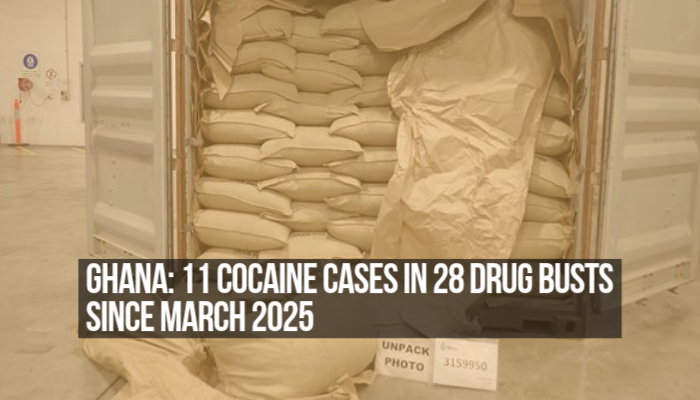
Ghana has recorded 11 cocaine cases in 28 drug busts since March 2025, according to a JoyNews Research tally of seizures by NACOC, the National Intelligence Bureau, the Ghana Police Service and foreign authorities.
The tally covers the period from March 2025 to September 22, 2026. It includes seizures made inside Ghana as well as seizures abroad of shipments that left from, or passed through, the country. The remaining 17 cases involved cannabis, methamphetamine, heroin, pharmaceutical opioids and consignments whose drug type was never made public.
JoyNews Research estimates the street value of the cocaine seized at between $1.3 billion and $1.7 billion.
Seven of the 11 cocaine busts were made in Ghana, and four were made abroad. Measured by weight, however, the picture reverses. The four foreign seizures, at Amsterdam, Antwerp and Dunkirk, came to about 12.4 tonnes. The seven seizures on Ghanaian soil whose weights were published came to about 3.6 tonnes. For every kilogramme of Ghana-linked cocaine stopped at home, more than three were stopped in Europe.
In June 2025, Dutch authorities intercepted nearly 4,500 kg of cocaine hidden in a wood shipment from Ghana, the largest seizure ever recorded at the port of Amsterdam. In November 2025, 2,829 kg was discovered in Antwerp concealed in cassava flour shipped from Tema. In December, a further 1,158 kg shipped from Ghana was seized at the same port, although it is not yet confirmed whether that case is separate from the November one.
In September 2026, French authorities at Dunkirk seized about 3.9 tonnes in a container declared as plastic waste, valued at €225 million (about $261 million). The shipment has been linked to a Dutch fugitive known as "Bolle Jos".
The largest seizure inside Ghana remains the 3,319.68 kg buried under sand in a tipper truck at Pedu Junction in Cape Coast in March 2025. The National Intelligence Bureau, which made the seizure, put its value at more than $350 million. A second truck carrying about 120 slabs was intercepted on the same highway the same day, though accounts differ on whether it was a separate operation.
Appearing before Parliament's Assurance Committee in July, the Interior Minister, Mohammed Mubarak Muntaka, said the Pedu cocaine had been destroyed, and the case was still in court. "Once we secure prosecution, we can update you on that," he told the committee.
Other seizures at home show the trade moving in different directions. At Kotoka International Airport, officers intercepted 89.74 kg in 73 slabs bound for the Netherlands in April 2025. "The barons apply chemicals on the slabs to disguise them," NACOC's Deputy Director-General, Alexander Twum-Barimah, said at the time. In February 2026, another consignment was discovered at the airport, concealed in packaged gari. In August 2026, 866 parcels hidden in gari sacks were intercepted at the Tema Harbour enclave as they were being loaded for export. In September, 192 wraps were seized in Wa after being moved from Kumasi, a reminder that some of the cocaine passing through the country is also being sold inside it.
The pattern is not limited to cocaine. In April 2026, Australian police seized 320 kg of methamphetamine concealed in charcoal shipped from Ghana, valued at A$296 million (about $210 million). Last month, a South African woman was arrested at OR Tambo Airport in Johannesburg with heroin after arriving from Accra, the third suspected courier held at that airport in three weeks.
The seizures have led to a string of arrests. A Nigerian national was picked up after NACOC's 192 kg Oyarifa operation in March 2025, and four people were arrested over the April 2025 Kotoka consignment. A senior manager of a manufacturing firm was arrested over the February 2026 airport seizure, and a Dutch national was among those detained after the Tema Harbour interception in August. NACOC arrested three people in connection with the December Antwerp shipment, and two suspects have been remanded over the Wa case.
In the Dunkirk case, the Presidency says ten people are being held, four of them officers of the Customs Division of the Ghana Revenue Authority. NACOC has rejected claims that any of the suspects served on the security details of the President or Vice President. "When we arrest people, we do checks," Mr Twum-Barimah said. No one has yet been convicted in connection with any of the major cocaine seizures.
Ghanaian authorities admit the threat is growing. In May, NACOC's Director-General, Brigadier General Maxwell Obuba Mantey, told Nigerian counterparts in Abuja that Ghana was no longer only a transit point for illicit drugs but was now dealing with rising local consumption. He said drug-related arrests rose by 197 per cent in 2025, and that traffickers were making greater use of maritime routes.
Marking World Drug Day in June, he had a warning for every trafficker, syndicate and network that thinks Ghana is open for business. "We are coming for you," he said. He put the country's seizures from 2025 to April 2026 at more than 8.5 tonnes of narcotics and 45.4 million tramadol tablets, with 217 arrests and 165 prosecutions.
A few days later, the Interior Minister said the drug trade "continues to exploit vulnerable systems and target impressionable minds for profit," and called for renewed national commitment to fight it.
Ghana-linked cocaine alone comes to about 16 tonnes on the JoyNews Research tally, close to twice the official 8.5 tonnes. Most of the difference is cocaine seized in Europe, which does not appear in Ghana's own statistics.
After the Dunkirk seizure, President John Mahama met security chiefs and ministers at Jubilee House on September 17. He directed an inter-agency task force to submit a roadmap within two weeks on stopping drugs from passing through Ghana's borders, and gave port agencies the same deadline to agree on a single operational framework. He also restored NACOC to joint container inspections at the ports, reversing a 2018 Cabinet decision that had removed it from that role.
According to officials at the meeting, the President promised agencies the scanners, logistics and personnel they need, but said they "must also deliver results and work together." Both deadlines fall due this week.
The scale of the problem is already visible from Europe. Figures released in January by Belgium's Federal Finance Department ranked Ghana fifth among the countries of origin for cocaine seized at the port of Antwerp in 2025, behind Ecuador, Costa Rica, Brazil and Colombia. Ghana was the only country outside South America in the top five.
Latest Stories
-
Baffour Awuah cooperating with investigators after surrender and arrest – EOCO
1 minute -
Destruction of aspirants’ posters breaches democracy—Ashanti NPP Communications Director
11 minutes -
BNI investigates Ampofo Ankrah over alleged $623,000 World Cup visa scheme
23 minutes -
NPP National Delegates Conference: Police announce road closures, diversions around Baba Yara Stadium
31 minutes -
Agric Committee demands financing plan for Pwalugu Irrigation Project before 2027 Budget
33 minutes -
Minority calls for the immediate suspension of Ghana-Colombia maritime agreement
44 minutes -
Ghanaian professional Sydney Hushie appointed UNFPA Chief of Digital Centre of Excellence
49 minutes -
GHS urges health managers to use community scorecards to improve healthcare delivery
56 minutes -
Ekyeamamfrom-Pivot irrigation project 90% complete but stalled over unpaid certificates
59 minutes -
When the Gavel speaks, where is the choir that once sang for Wontumi?
60 minutes -
NPP does not need a new chairman: It needs a brand architect
1 hour -
GNFS contains fire at Avenor North Industrial Area in Accra
1 hour -
NITA appoints Anthony Owusu-Ansah as Acting Deputy Director-General
1 hour -
RANA warns Salomey Bafoh case could have chilling effect on free expression
1 hour -
Who is the ‘hero’ Indian pilot who was stabbed on Israel-bound flight?
1 hour