

Audio By Carbonatix
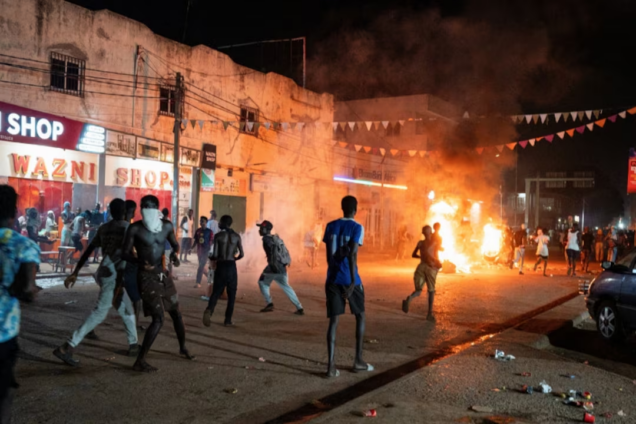
Gambia's police chief has announced that no further protests will be allowed in the West African nation without permits, after authorities used tear gas earlier in the week to disperse crowds that had formed to denounce prolonged power cuts during the hottest months of the year.
The protests over multiple nights highlighted frustration with President Adama Barrow ahead of the December elections.
"From this very moment, nobody is allowed to protest without an approved permit," Seedy Mukhtar Touray, Gambia's inspector general of police, said in a statement late Thursday.
"Nobody is allowed to converge, cause havoc, distort the peace and tranquility of the nation, especially during the night. Any violation to this will be met with necessary force."
During the unrest earlier this week, a police post was vandalised and "detainees were unlawfully released from custody", Touray said, while the national utility, National Water and Electricity Company Ltd (NAWEC), said it had closed three branches after attacks severely damaged buildings, infrastructure and office equipment.
Authorities have arrested 11 people in connection with vandalism during the unrest, Touray said.
'YOUTHS ARE FRUSTRATED', OPPOSITION CANDIDATE SAYS
In an interview with Reuters, Talib Ahmed Bensouda, mayor of Kanifing Municipality, said he understood why protesters were upset.
"If you can't sit in your house because of the heat. If you don't have [a generator] to do basic business or even to carry out informal activities… you're forced to take the matter to the streets," said Bensouda, who plans to challenge Barrow in the December election. "That's not something we support, but we understand the matter."
NAWEC said in a statement on August 15 that it was experiencing "an unforeseen surge in electricity demand during the peak period," which it attributed to high temperatures.
Barrow visited NAWEC facilities on Tuesday morning and promised that Gambia would receive new generators this week and restore electricity by the end of October.
He said the government was in the final stage of installing an additional 24-megawatt generation machine and that it awarded a contract for a 50-MW solar power plant.
But Bensouda faulted Barrow for relying too much on energy imports, leaving Gambia exposed to global supply disruptions.
"Youths are frustrated, and I think not just about energy, they're frustrated about a lot of things," Bensouda said. "There's a lack of opportunity and this is what's driving irregular migration to Europe."
Latest Stories
-
No more pothole ambulance rides: Mahama’s roads will change lives – Agbodza tells Upper West farmers
13 minutes -
‘Physically better’ Kudus can start against Liverpool – De Zerbi
19 minutes -
Bonsu Baah sets up opener in Al Qadsiah win over Al Wasl
32 minutes -
Ghana has now become a distribution hub for drugs
51 minutes -
Africa Nations Volleyball Championship: Ghana’s Black Spikers leave for tournament in Tunisia
1 hour -
Today’s Front pages: Tuesday, September 15, 2026
1 hour -
Auditing the Auditor-General: How special audit understated a COVID-19 expenditure
2 hours -
A Partnership for Progress: Why the ProMark–KPMG collaboration matters for Africa’s digital assets future
2 hours -
Catholic Bishops pressure gov’t to sign long-delayed mission schools agreement
3 hours -
Cedi under fresh pressure as Christmas import demand drives dollar surge
4 hours -
Ato Forson eyes first-week November for 2027 Budget, promises jobs and major infrastructure push
4 hours -
Catholic Bishops demand probe into ‘protocol admissions’ amid SHS placement challenges
4 hours -
SHS placement: Catholic Bishops demand probe into alleged payments for school places
4 hours -
Facts about Nigeria’s Dangote oil refinery Initial Public Offering
5 hours -
Trump says AI safety fears a ‘hoax’ as he rejects calls for greater safeguards
5 hours