

Audio By Carbonatix
Residents of Okroase in the Ahafo Ano Southwest district of the Ashanti Region are living in fear over a possible flooding situation as illegal mining operations redirect the flow of the Mankran Stream.
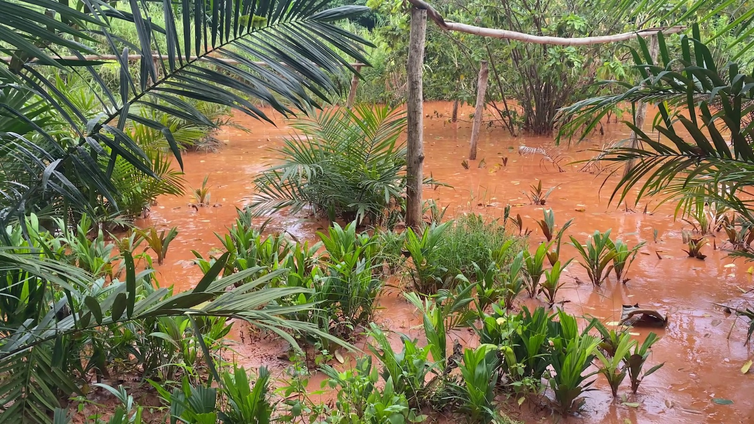
Already, the diverted milky sludge from the water body from the artisanal mining activities has destroyed several acres of rice farms and a commercial coconut and oil palm nursery, running into millions of cedis.
Emmanuel Amponsah was visibly distraught over the destruction of his over 200,000 cedis worth of investment in oil palm and coconut seedling plantations.
He nursed the seedlings for months, hoping to raise healthy planting materials for farmers and land reclamation projects.
Footage captured days when the Mankran Stream, heavily laden with silt, overflowed its banks and flooded the nursery.
After the water receded, the extent of destruction remains visible.
The once-thriving nursery is now covered in mud and debris, with several coconut and oil palm seedlings completely damaged.
“I regret coming here. I was at Mankranso, and they destroyed over 2,000 seedlings there. I came here only for this to happen again. It’s like a perennial problem,” he worriedly said.
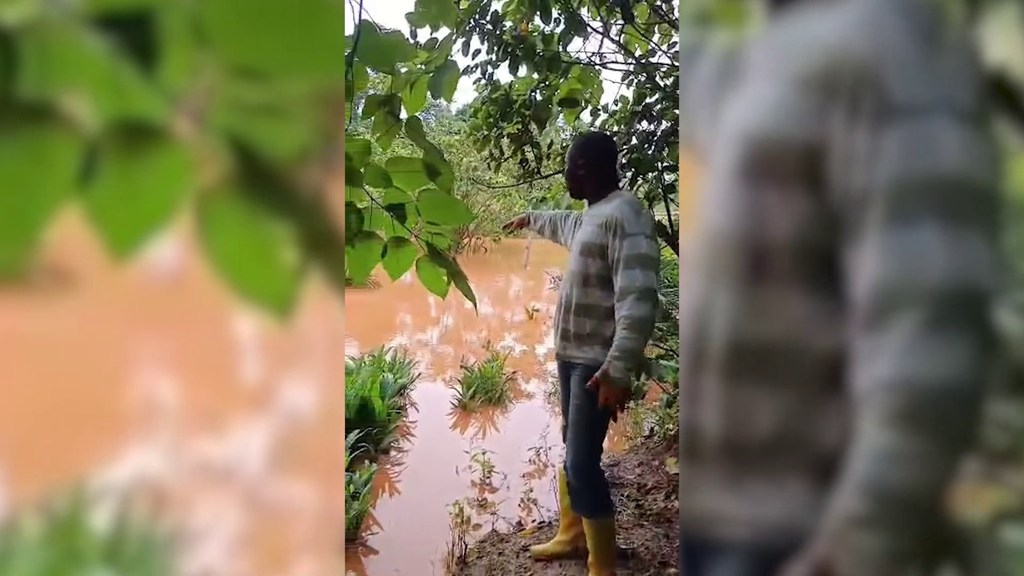
Just across from Amponsah’s nursery, another farmer is counting his losses.
Nana Yaw and his wife cultivated their rice plantation at the beginning of the year, looking forward to a good harvest to support their household.
But today, they watch, in discontent, their one-acre rice farm now submerged in milky sludge from the Mankran River.
“This is very sad. No farmer would be happy seeing their farm in this bad state. I have made losses,” Nana Yaw said.
His wife continued that: “It’s not as if the rice couldn’t grow bountifully. It did, but the water has destroyed everything. The illegal miners care less about us”.
The cause of the devastation on the two farms sits only a few kilometers away – illegal mining.
For months, miners have excavated land close to farmlands and residential areas, leaving behind heaps of excavated material.
The farmers say the earthworks have altered the natural course of the stream, forcing water into adjoining farms.
Effluent and heavy sediment from the mining areas have also accumulated in the waterway, choking culverts beneath a nearby bridge.
Community folks made efforts to halt their operations, but the miners continue to dig deep into the earth’s crust, with the nearby communities bearing the brunt of the devastation.
“I went there to sack them, but I was told they came back. Should our children and parents die before they stop?” a resident asked.
The Mankran stream is traditionally one of Ghana's oldest rivers, historically believed to be protected by a powerful river deity named Nana Mankran.
For generations, the water body remained clear and pure, serving as the primary source for drinking, domestic chores, farming, and local fishing.
But the same can’t be said now. It is now a pale shadow of the once crystal-clear water body.
“We used to drink and swim in the stream. But we can’t do that now due to illegal mining,” Kontihene for the community said.
Driving from Okroase through adjoining communities, including Kunsu and Mankranso, the signs of land degradation are difficult to miss.
Large stretches of land along the Mankranso-Tepa Road have been excavated, leaving behind exposed earth and abandoned mining pits.
Satellite imagery of the area also shows extensive muddy patches across what was previously green agricultural land.
The communities have pushed for local government authorities to halt the operations and de-silt the waterway, but that seems to have fallen on deaf ears.
“They promised to de-silt during the harmattan. We’ve informed the assemblyman several times,” the unit committee chairperson for the area said.
But with the rainy season and the stream already struggling to contain its flow, residents say the danger remains.
They fear a major downpour could send floodwaters into nearby homes and farms, causing even greater damage.
“Whenever it floods, the water enters our home. We don’t want any disaster here,” the Kontihene indicated.
Back on Amponsah’s farm, he grows the seedlings to support reclamation of degraded lands and for cash crop production.
Amponsah usually cultivates 58 plant species, including citrus fruits and tree crops, but the incessant destruction of his nursery is compelling him to cut down to 6 plants for the new planting season.
For now, farmers and residents say they need immediate intervention to restore the natural flow of the Mankran Stream, protect their farms, and prevent a possible flood disaster.
Until that happens, the people of Okroase remain anxious each time the rains begin.
Latest Stories
-
Photos from National Conference on Housing Finance
3 minutes -
Italy, Ghana unite 40 artists for ‘Beyond Creation’ exhibition at Accra Art Centre
22 minutes -
Premature to call for Sports Minister’s removal while CID probe is ongoing – Ernest Norgbey
42 minutes -
NPP mourns Samuel Arthur Odoi-Sykes
59 minutes -
Stay out of World Cup visa probe to avoid interfering with CID investigations – Ernest Norgbey to politicians
1 hour -
Bono East Minister inspects ‘Big Push’ roads; contractor on Tankor-Fiema-Busunya road ahead of schedule
1 hour -
Scrutiny is not disloyalty – Chief of Staff defends serious journalism at 30th GJA Awards launch
1 hour -
Abuse case: Nana Akua’s husband Harold unable to appear in court after hospital admission – Police
2 hours -
Mahmud Kabore picks NDC Ashanti Regional Communication Officer nomination forms
2 hours -
KNUST Career Services pioneer Selina Doe Angmor named among 2026 40 Under 40 honourees
2 hours -
Nana Akua domestic abuse case: Police to arraign husband after hospital discharge
2 hours -
NHIS coverage rises to 70% after government uncaps levy – Health Minister
2 hours -
World Cup visa scandal: I’ll go after anyone who dents Mahama’s gov’t – Ernest Norgbey
2 hours -
GCNM calls for a permanent office complex, more funding for specialist nursing training
2 hours -
Salomey Awiti Baffoe reunites with family after GH¢100k bail
2 hours