

Audio By Carbonatix
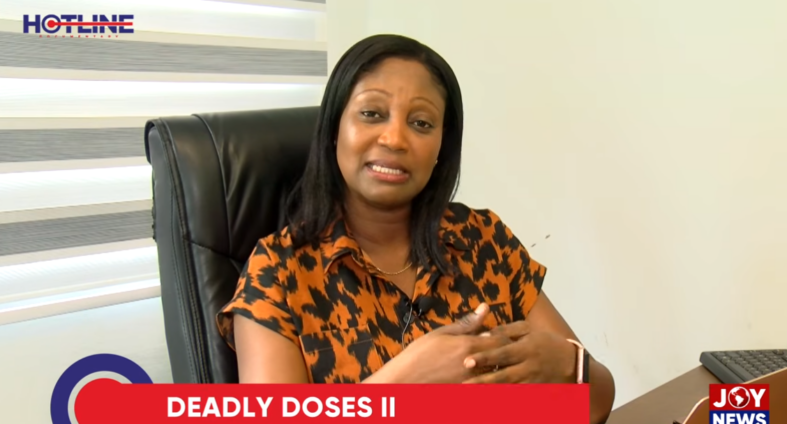
A psychiatrist, Dr Ruth Owusu Antwi, has revealed that her youngest patient treated for substance abuse at her facility began using drugs while in Primary Three, highlighting the growing threat of drug addiction among children in Ghana.
Speaking to JoyNews on the Hotline documentary, Deadly Doses II: Ghana's Growing Drug Crisis, Dr Owusu Antwi said the case demonstrates how early exposure to drugs can quickly develop into addiction.
According to her, the young boy became addicted after repeatedly watching older people smoke near his school.
"The youngest patient started using drugs. In fact, he was recently on the ward," she said.
"He started using drugs at Class Three. That's Primary Three."
Dr Owusu Antwi explained that the child would often see older people hiding behind his classroom to smoke. After they left, he would collect what remained and use it himself out of curiosity.
"He would look at older people come and hide behind his classroom and smoke. And out of curiosity, when they had left, he'd go and pick the pieces," she recounted.
According to the psychiatrist, what began as curiosity soon turned into addiction because of the effect the drugs had on the child.
"He became hooked to it. He became happy with the effect it gave him."
She said the child continued using the drug "one piece at a time" until he eventually required psychiatric treatment.
"We saw him on the ward when he was around 13 years old. We discharged him, I think, a week ago. But he started at Primary Three," she said.
Dr Owusu Antwi said the case reflects a worrying trend in Ghana's growing substance abuse crisis, where children and young people are becoming exposed to drugs at increasingly younger ages.
She also cited findings from her facility's 2025 Annual Performance Review, which showed that the majority of patients treated for mental health conditions, including substance use disorders, were young adults.
"Looking at our 2025 annual performance review, we are realising that for all disorders, including addictions, the age category that topped was from 20 to about 49. Which is largely the schooling-to-working age group," she said.
Illicit substances are increasingly reaching schools, university campuses and popular food and drinks consumed by young people.
Part Two of Deadly Doses: Ghana’s Growing Drug Crisis reveals how traffickers are moving beyond the open sale of narcotics in drug ghettos. Marijuana, opioids and other substances are now being concealed in products such as sobolo, brownies and gummies, making them more difficult to detect.
Latest Stories
-
Big Push probe: Presidential staffer challenges Fourth Estate’s report on Valerie Sawyerr committee
36 minutes -
Since Gold Coast, national security has never faced an open trial – Atta Akyea
36 minutes -
This is no case for junior lawyers – Atta Akyea explains why he must defend Adu-Boahene
55 minutes -
Lebanon parliament votes to abolish death penalty
56 minutes -
Ghana, Burkina Faso sign defence pact to secure cross-border trade corridors
1 hour -
The rise of AI in the classroom: Balancing technological innovation with critical thinking
1 hour -
Five arrested over alleged MoMo robbery syndicate in Upper West
1 hour -
UEW journalism students call for practical media studio
2 hours -
Why these 2 cases? – Atta Akyea questions Chief Justice’s expedited trial order
2 hours -
Beyond certification: How Bawaa the artist is helping young creatives turn talent into opportunity
2 hours -
The Law 101: Vacation warrants and the role of the CJ (Part IV)
2 hours -
The Law 101: GBA states pure law and convention about Legal Vacation (Part III)
2 hours -
Pray – THE LAW 101: The Vacation Roster dilemma and the reality of Court Recess (Part II)
2 hours -
Trump hid in catering truck in secret plane swap over Iran threat, reports say
2 hours -
Inside the Secret Service ‘shell game’ to hide US presidents in plain sight
2 hours