

Audio By Carbonatix
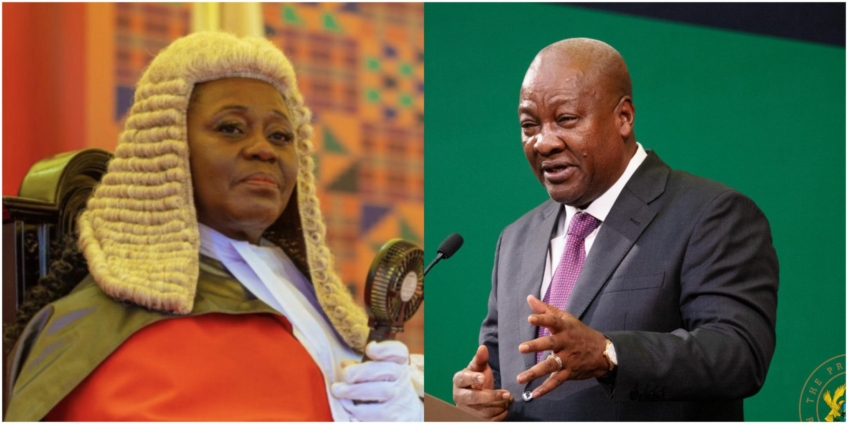
Chief Justice Gertrude Torkornoo has submitted her preliminary response to President John Mahama following petitions seeking her removal from office.
This development comes as the 10-day window granted to her to respond to the petitions elapses today, Monday, April 7.
The petitions were received by the President earlier last month and have triggered national attention, prompting legal and constitutional debates on the appropriate procedure for handling such matters.
Justice Torkornoo, in a letter addressed to the President last week, had requested copies of the petitions and asked for at least seven days to respond, in line with the requirements of due process and fairness.
Her response, now formally submitted to the President and the Council of State, is expected to be considered as part of the consultation process with the Council of State under Article 146(6) of the 1992 Constitution.
The submission marks a significant milestone in the unfolding constitutional process that could determine whether a committee will be established to investigate the allegations against the Chief Justice.
Meanwhile, the Supreme Court is set to hear a suit on April 9, filed by Old Tafo MP Vincent Ekow Assafuah, challenging the legality of the President initiating the removal process without first notifying the Chief Justice.
The law that surrounds the removal of the Chief Justice is enshrined in Article 146 of the constitution.
Article 146 - Removal Of Justices Of Superior Courts And Chairmen Of Regional Tribunals
1) A Justice of the Superior Court or a Chairman of a Regional Tribunal shall not be removed from office except for stated misbehaviour or incompetence or on ground of inability to perform the functions of his office arising from infirmity of Body or mind.
(2) A Justice of the Superior Court of Judicature or a Chairman of a Regional Tribunal may only be removed in accordance with the procedure specified in this article.
(3) If the President receives a petition for the removal of a Justice of a Superior Court other than the Chief Justice or for the removal of the Chairman of a Regional Tribunal, he shall refer the petition to the Chief Justice, who shall determine whether there is a prima facie case.
(4) Where the Chief Justice decides that there is a prima facie case, he shall set up a committee consisting of three Justices of the Superior Courts or Chairmen of the Regional Tribunals or both, appointed by the Judicial Council and two other persons who are not members of the Council of State, nor members of Parliament, nor lawyers, and who shall be appointed by the Chief Justice on the advice of the Council of State.
(5) The committee appointed under clause (4) of this article shall investigate the complaint and shall make its recommendations to the Chief Justice who shall forward them to the President.
(6) Where the petition is for the removal of the Chief Justice, the President shall, acting in consultation with the Council of State, appoint a committee consisting of two Justices of the Supreme Court, one of whom shall be appointed chairman by the President, and three other persons who are not members of the Council of State, nor members of Parliament, nor lawyers.
(7) The committee appointed under clause (6) of this article shall inquire into the petition and recommend to the President whether the Chief Justice ought to be removed from office.
(8) All proceedings under this article shall be held in camera, and the Justice or Chairman against whom the petition is made is entitled to be heard in his defence by himself or by a lawyer or other expert of his choice.
(9) The President shall, in each case, act in accordance with the recommendations of the committee.
(10) Where a petition has been referred to a committee under this article, the President may-
(a) in the case of the Chief Justice, acting in accordance with the advice of the Council of State, by warrant signed by him, suspend the Chief Justice;
(b) in the case of any other Justice of a Superior Court or of a Chairman of a Regional Tribunal, acting in accordance with the advice of the Judicial Council, suspend that Justice or that Chairman of a Regional Tribunal.
(11) The President may, at any time, revoke a suspension under this article.
Latest Stories
-
Kusaal Wikimedians take local language online in 14-day digital campaign
40 minutes -
Stop interfering in each other’s roles – Bole-Bamboi MP appeals to traditional rulers for peace
56 minutes -
President Mahama to address nation in New Year message
1 hour -
Industrial and Commercial Workers’ Union call for strong work ethics, economic participation in 2026 new year message
3 hours -
Crossover Joy: Churches in Ghana welcome 2026 with fire and faith
3 hours -
Traffic chaos on Accra–Kumasi Highway leaves hundreds stranded as diversions gridlock
3 hours -
Luv FM Family Party in the Park: Hundreds of families flock to Luv FM family party as more join the queue in excitement
4 hours -
Failure to resolve galamsey menace could send gov’t to opposition – Dr Asah-Asante warns
4 hours -
Leadership Lunch & Learn December edition empowers women leaders with practical insights
4 hours -
12 of the best TV shows to watch this January
4 hours -
All-inclusive Luv FM Family Party underway with colour, music, and laughter as families troop in to Rattray Park
5 hours -
Jospong Group CEO, wife support over 5,000 Ghanaians with food, cash on New Year’s Day
6 hours -
Life begins at 40: A reflection on experience and leadership
7 hours -
Maresca leaves Chelsea after turbulent end to 2025
7 hours -
NPP still hurting after 2024 loss – Justin Kodua
7 hours