

Audio By Carbonatix
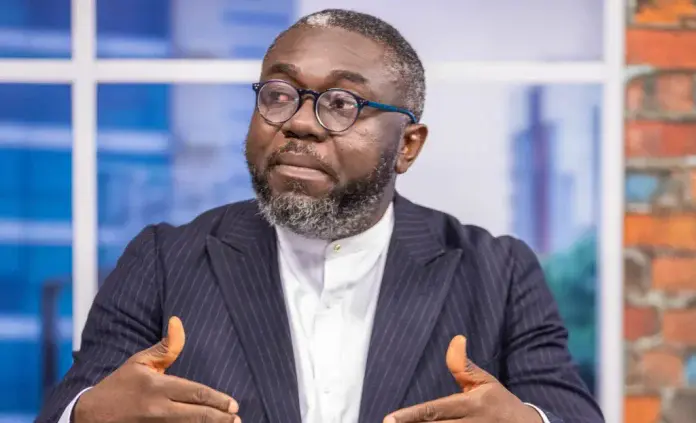
Lawyer and social activist Oliver Barker-Vormawor has raised serious concerns over the reported arrest of a middle-aged nurse, Salomey Awity Bafoh, who has allegedly been linked to the anonymous TikTok account “Ghana Jollof”.
Ms Bafoh, a 40-year-old mother of three from Techiman, was reportedly taken from her home in Hansua in the Bono East Region around midnight on Sunday, September 13, by three individuals who identified themselves as National Security operatives.
Her family has denied any connection between her and the “Ghana Jollof” account, which has been critical of President John Dramani Mahama and First Lady Lordina Mahama. Regional Police and National Security officials have also reportedly said they had no knowledge of her arrest at the time, deepening concerns over her whereabouts.
Reacting to the development in a Facebook post, Mr Barker-Vormawor said he was concerned by reports that a nurse who had never been to Accra had suddenly been accused of involvement in a treason plot involving another TikToker.
“I am concerned by reports that a middle-aged nurse who has never been to Accra has now, out of nowhere, been accused of a treason plot involving another TikToker known for insulting politicians linked to the current government,” he wrote.
He said he hoped the development would not represent a return to what he described as the “Addo-Danquah/Dame years”, arguing that the circumstances surrounding the case were concerning.
“I pray seriously that this is not a return to the Addo-Danquah/Dame years. From all indications, it looks like it; and that’s concerning,” he stated.
Mr Barker-Vormawor stressed that an allegation as serious as treason must be supported by compelling evidence and handled with professional judgment.
“An accusation of such gravity demands a corresponding seriousness of evidence and professional judgment. The state cannot create public alarm and fail to show proof of it,” he said.
He further argued that treason allegations carry significant implications for the relationship between citizens and the state because they can portray an individual as a threat to Ghana’s constitutional order.
“Treason occupies a particularly dangerous place in the relationship between citizens and power. It allows the state to present an individual as a threat to the continued existence of the constitutional order. The potential for abuse is precisely why its invocation requires exceptional care,” he wrote.
According to him, if investigations establish that the police advanced the allegation without a credible evidential basis, responsibility must be assigned to the senior officers involved in the decision-making process.
“And so if it emerges that the police advanced this allegation without a credible evidential basis, the President should demand the resignation of the senior officers responsible for authorising or knowingly sustaining it. Responsibility must follow the chain of decision-making,” he stated.
Mr Barker-Vormawor also cautioned against what he described as the misuse of national security considerations to justify poor professional judgment.
“The language of national security cannot become an intellectual refuge for professional incompetence. Those entrusted with coercive power must possess the judgment to distinguish an actual threat from something that merely offends their political sensibilities. Their failure to make that distinction can make a mockery of the State itself,” he said.
He added that he had previously warned the government about what he described as the liberal use of policing powers and what he considered heavy-handed actions against social media commentators.
“I have on my occasions had reason to warn the Government about the liberal abuse of policing powers and the heavy handed crackdown of social media commentators,” he stated.
He questioned the priorities of the state, arguing that greater urgency appeared to be attached to pursuing social media commentators than addressing other threats affecting the country.
“I will keep repeating this. A nation that pursues TikTokers with greater urgency than those poisoning its rivers or plundering its public resources reveals a distorted conception of security. It becomes exquisitely sensitive to affronts to authority and dangerously indifferent to injuries to the public,” he wrote.
Mr Barker-Vormawor concluded by expressing concern about what he described as institutional unseriousness and its consequences for ordinary citizens.
“We play too much in this country. And too often, ordinary citizens pay for that level of institutional unseriousness.
Latest Stories
-
Ashanti region records 25% drop in maternal mortality in first half of 2026
7 minutes -
Ghana’s unemployment situation is ‘scary’ – NSA Ashanti regional Director
14 minutes -
Photos: Mahama chairs security meeting over drug trafficking through Ghana’s ports
19 minutes -
Constitutional Review: 5-year term means extra year to amass wealth, loot state coffers — Ansa-Asare
22 minutes -
Bekwai MP rewards top BECE performers as academic results improve
22 minutes -
NIA marks Identity Day with public education float, mass registration exercise
25 minutes -
Mahama directs inter-agency task force to submit roadmap to deal with drug trafficking in two weeks
26 minutes -
Gender Ministry tasks women in media to drive Affirmative Action Act implementation
28 minutes -
MoFA launches National Horticultural Seed Roadmap to improve access to quality seeds
31 minutes -
10 people, including 4 Customs officers held as Ghana probes drug trafficking through ports
40 minutes -
Kwabenya Court denies bail to six over suspected 3.9-tonne cocaine shipment
49 minutes -
Sports Ministry spent $1.26m on 2,922 World Cup tickets — Kofi Adams
58 minutes -
India faces 100% tariff threat over Russian oil after US House vote myjoyonline
1 hour -
The importance of World Tourism Day celebrations in Ghana and across the globe
1 hour -
Over 100 pupils cram into one classroom as Amantin Basic School battles congestion
1 hour