

Audio By Carbonatix
Investigation by Manasseh Azure Awuni
A years-long investigation has revealed that the Auditor-General’s special audit into Ghana’s COVID-19 expenditure significantly understated a major cost incurred across multiple ministries. Evidence gathered points to a deliberate omission of hundreds of millions of cedis spent by entire ministries.
The special audit was carried out in late 2022 upon the request of then Minister of Finance Ken Ofori-Atta, who has been charged with corruption and corruption-related offences for his role in the SML scandal and is now fighting his extradition from the United States to face justice in Ghana.
In a letter dated July 14, 2022, Finance Minister Ken Ofori-Atta requested the Auditor-General to conduct a special audit of “COVID-19 expenditures by ministries, departments and agencies for the period 2020 to June 2022.”
Mr Ken Ofori-Atta requested that the audit be completed within three months. The special audit report was dated December 30, 2022.
In the special audit, the Auditor-General revealed that Ghana sourced GH¢21.8 billion “from the Contingency Fund, the World Bank Group, the International Monetary Fund (IMF), the African Development Bank (AfDB), the European Union (EU) and the sale of BOG-COVID-19 Bonds for the 2020, 2021 and 2022 Fiscal Years to finance the Coronavirus Alleviation Programme and implementation of the Ghana COVID-19 Emergency Preparedness and Response Plan, as well as Budgetary Support.”
One of the audit objectives, as stated by the Auditor-General in its report, was to “ascertain whether the financial records fairly present the COVID-19 fund receipts and payments.”
This investigation, however, has revealed that the special audit failed to accurately present how much the government spent on the COVID-19 pandemic. The investigation focused on fumigation, a major government intervention in Ghana's fight against COVID-19.
The audit significantly understated the cost of multiple fumigation exercises despite having information on the expenses incurred by the ministries that carried out the exercise.
The Auditor-General’s special audit stated the “cost of fumigation” as GHS 96 million ($8.7 million).
This investigation, which covered three ministries — Education, Transport and Local Government — revealed that Ghana spent at least GHS 780 million (about $70 million) on COVID-19 fumigation.
The Auditor-General’s figure represents only about 12% of the total expenditure on COVID-19 fumigation.
The expenditure could be higher, as other state agencies also carried out COVID-19 fumigation exercises. The police, prisons, and the military, as well as other ministries, departments, and agencies (MDAs), also carried out COVID-19 fumigation and disinfection exercises.
Of the GHS 780 million COVID-19 fumigation expenditure this investigation uncovered, about GHS 775 million (99.4%) went to one company, Zoomlion Ghana Limited.
Prior to the COVID-19 fumigations, both the activity and the company that undertook it, Zoomlion Ghana Limited, had been indicted in major corruption and corruption-related probes.
Zoomlion had been flagged by multiple state agencies, including the Auditor-General. The World Bank, for instance, blacklisted Zoomlion Ghana Limited in the past for admitting to paying bribes.
The Auditor-General had described Zoomlion in 2019 as a “fraudulent drain on the country” after uncovering malfeasance in another shady, multi-year fumigation contract awarded to the company by the Ministry of Health.
During the COVID-19 Pandemic, Zoomlion already had multiple fumigation contracts covering all of Ghana, which the state paid for separately.
A December 2025 report submitted to cabinet by three ministers describes Zoomlion’s capture of the sanitation sector as a national “security risk.”
The cabinet report, signed by the Minister for Finance, Cassiel Ato Forson; the Minister for Local Government, Ahmed Ibrahim; and the Minister for Youth Development and Empowerment, George Opare-Addo, said:
“This discomfort seeps through as you read [Zoomlion’s] contract after contract in various spheres of the sanitation landscape, giving the impression of an autocratic monopoly that should not be accepted in a democratic state. As indicated, this poses a security risk to the country.”
Dated December 17, 2025, the “secret” report was submitted to the cabinet, which is chaired by President John Mahama. The president set up the inter-ministerial committee following previous investigations and a 2025 petition by this reporter.
Current Investigation

This current investigation into the understatement by the Auditor-General uncovered findings backed by contract documents, Public Procurement Authority (PPA) approval and ratification letters, the Ministry of Finance Budget Statement to Parliament, as well as responses to right to information (RTI) requests made to the three ministries, the Ghana Airports Company Limited (GACL) and the Ghana Audit Service.
As this report reveals, the scientists instrumental in Ghana’s COVID-19 response said Ghana’s fumigation efforts were ineffective in the fight against COVID-19. Even if fumigation had been necessary, this investigation provides evidence that Ghana had multiple fumigation and disinfection contracts covering every district in the country, which could have been redirected to fight the pandemic.
Understatement of Fumigation Expenditure
In the special audit of the Government of Ghana’s COVID-19 expenditure, the Auditor-General stated GH¢152,491,616 under the heading, “The cost of quarantine and fumigation.”
Of that figure, the audit report said GH¢96,323,102.05 was spent on fumigation.
After years of investigation, including petitions to the Office of the President and the Right to Information Commission following the denial of requested information, figures gathered from three Ministries indicate the cost of fumigation was far higher than what the Auditor-General recorded.
Ministry of Education
Between June 2020 and March 2021, the Ministry of Education undertook three phases of fumigation towards the reopening of schools. Contract documents show that the GH¢96,323,102.05 published by the Auditor-General as the “cost of fumigation” represents only the second phase of the Ministry of Education’s fumigation exercise.
Contract documents show that the first phase of the Ministry of Education’s fumigation contract was signed on July 24, 2020, for GH¢100,990,000. It was signed between Zoomlion Ghana Limited and the Ghana Education Service, an agency under the Ministry of Education.
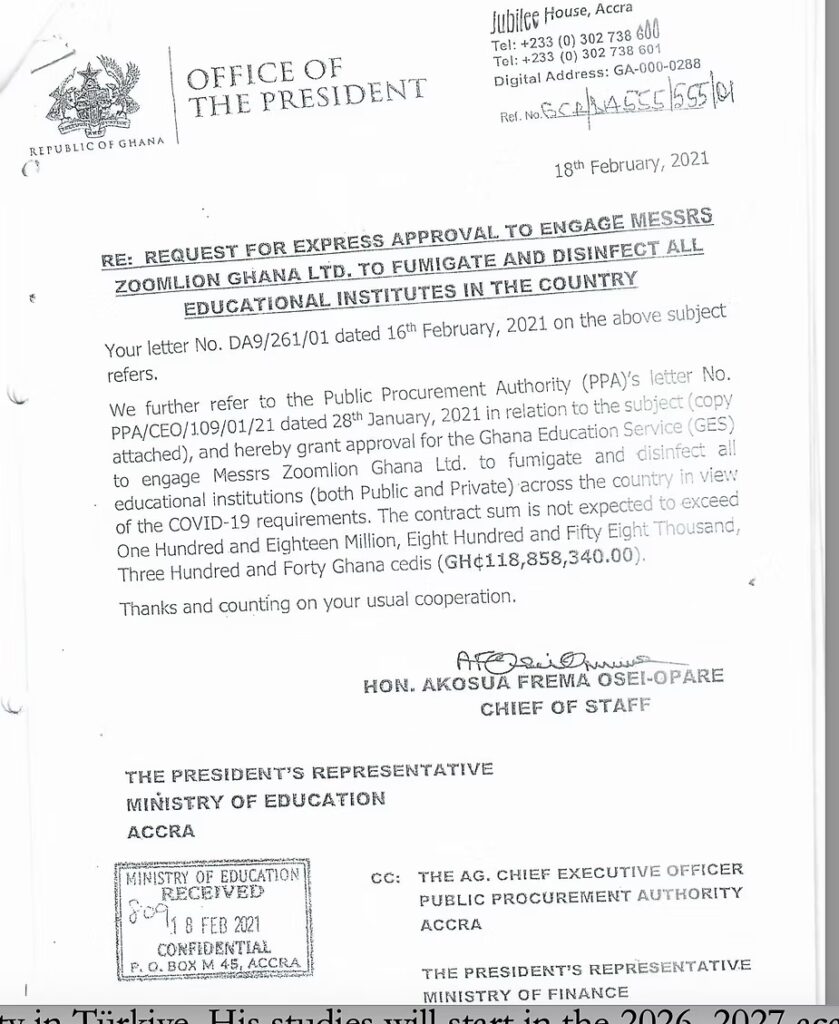
Phase two of the school’s fumigation contract was signed on September 24, 2020, at a cost of GHS96,323,102, while the third phase was signed on March 1, 2021, at a cost of GH¢118,858,340.
In all, the Ministry of Education spent GHS 316.1 million on COVID-19 fumigation per the contract documents secured in the course of this investigation.
The Auditor-General’s report, however, captured only GHS96 million, the least amount spent across the three phases by only one ministry.
The Ministry of Local Government, Decentralisation and Rural Development
The Ministry of Local Government, Decentralisation and Rural Development (MLGDRD) spent a total of GHS 299 million across three phases of the market fumigation exercise, which it contracted to Zoomlion between April 2020 and November 2020.
However, the Auditor-General’s special audit did not mention any fumigation expenditure undertaken by the ministry. This is despite the ministry submitting its fumigation expenditure to the Auditor-General during the audit.
After three years of petitioning for the contracts, the ministry finally released some documents to this reporter on its fumigation expenditure.
From the documents, the MLGDRD awarded the first contract to Zoomlion in April 2020 using the single-source procurement method, without obtaining the mandatory approval from the PPA. (The PPA later ratified the contract in July that year.)
The April 2020 contract awarded to Zoomlion to fumigate open markets and other public spaces cost the state GHS76.6 million.
On June 9, 2020, the ministry signed another contract with Zoomlion for the same service at a cost of GHS76.6 million.
The ministry again signed a similar fumigation contract with Zoomlion on November 27, 2020, this time at GHS145.8 million, nearly double the cost of the first two contracts.
None of these expenditures was captured in the Auditor-General’s special audit as part of “the cost of fumigation”, though the Auditor-General admitted to this reporter knowledge of the expenditure.

Ministry of Transport
Another Ministry whose fumigation spending the Auditor-General failed to include in its special audit was the Ministry of Transport, which paid Zoomlion a total of GHS159.9 million for fumigations in 2020, 2021, and 2022.
This ministry paid GHS 31.98 million for fumigation in 2020.
In 2021, it again spent GHS 31.98 million for fumigation.
Then, in 2022, when the impact of the pandemic had diminished due to vaccination and the nation had returned to near normalcy, the Ministry of Transport tripled its COVID-19 fumigation spending, paying Zoomlion GHS 95.9 million to fumigate the same spaces it had paid the company a third of that amount to fumigate in the two previous years.
The Ministry of Transport has confirmed these figures but refused to release its fumigation contracts with Zoomlion, claiming that the contract “contains commercial information supplied in confidence, the disclosure of which can reasonably be expected to prejudice the competitive position of the service provider.”
The Education and Local Government ministries released their fumigation contracts awarded to the same company after years of my follow-up requests and petitions, including a ruling by the Right to Information Commission.
The PPA, which approved the single-source procurement method used to handpick Zoomlion for the contracts, stated in its approval letters that the ministries should publish their contracts on the PPA's website, a directive the ministries flouted.
The Ghana Airport Company Limited
The Ghana Airport Company Limited, an agency under the Ministry of Transport, said it spent GHS4,603,734 on COVID-19 fumigation and disinfection services in 2020, 2021, and 2022. The contracts were awarded to four companies—KNK, Dura, Kanof and Emmerxon—to undertake COVID-19 fumigation at various airports and aviation facilities, the areas the Ministry of Transport claimed it contracted Zoomlion to fumigate.
The Auditor-General’s Response
The COVID-19 special audit, undertaken between July 2022 and December 2022, was overseen by Johnson Akuamoah Asiedu, whom President Nana Addo Dankwa Akufo-Addo appointed after the president removed Mr Asiedu’s predecessor from office in 2020. (The Supreme Court of Ghana ruled in 2023 that the president’s removal of the Auditor-General was unconstitutional.)
The omission of significant fumigation expenditure from the audit report was not an oversight or the result of the auditors' lack of information on the expenditure.
In August 2022, when this reporter requested information on fumigation contracts from the Local Government Ministry, the ministry responded in a letter dated September 6, 2022, that “access to the information you request is deferred due to the fact that documents required have been submitted for auditing.”
The Ghana Audit Service, in a response letter dated February 14, 2025, confirmed that it audited the Local Government Ministry's fumigation expenditure. However, the Ghana Audit Service, however, failed to state why it omitted that ministry’s expenditure from the “cost of fumigation” captured in its special audit report.
The Ghana Audit Service responded to this reporter's question, saying, “the absence of the Ministry of Local Government's expenditure on fumigation and disinfection in the Auditor-General's Report in question does not mean the expenditure was not audited.”
The Ghana Audit Service also confirmed that it audited Phases 1 and 2 of the Ministry of Education’s COVID-19 expenditure, but it failed to explain why it presented only the second phase’s expenditure as the “cost of fumigation” in its report.
When asked to provide an explanation for “what appears to be a cover-up and a deliberate understatement of the expenditure on the COVID-19 fumigations,” the Ghana Audit Service said:
“The last statement made by you [Manasseh Azure Awuni], as captured in point 11 above, seems more like an allegation rather than a request for information."
View of a former Auditor-General
A former Auditor-General, Daniel Domelevo, said a special audit of that nature should have included the full expenditure of the money raised for the COVID-19 pandemic.
Mr Domelevo, who was Ghana’s Auditor-General when the COVID-19 expenditures started, also described Ken Ofori-Atta’s request for the audit as a legal anomaly.
According to him, the law mandates the Auditor-General to carry out periodic audits of public institutions or special audits when necessary. Apart from that, the Parliament of Ghana and the President, acting on the advice of the Council of State, can also request special audits. He said the Minister of Finance, who was the chief spending officer and an “auditee” in the COVID-19 special audit, should not have initiated the audit.
“This is not grounded in law," Mr Domelevo said. "If the auditee tells you to ‘come and audit me,’ it is loaded. It raises red flags.”
Needless Fumigation, Needless Expenditure
Ghana’s fumigation exercises, for which hundreds of millions of cedis were spent, were not backed by science, according to information from Ghana's scientific community and international COVID-19 guidelines published in the early days of the pandemic.
The government of Ghana shut down all schools and educational facilities four days after the first COVID-19 case was recorded in the country. At the time, no school in Ghana had recorded a COVID-19 case. When schools were due to be opened, more than three months later, the president announced that all schools in the country would be fumigated before students returned.
“If it [a school] was shut for three months, who went in there and introduced the virus? And is the virus going to stay for three months? From all that we have read, it’s [the lifespan of the virus on surfaces] from two hours to nine days,” said Dr J.H. Kofi Bonney, a senior research fellow at the Noguchi Memorial Institute for Medical Research, the institution that led Ghana’s testing and research during the COVID-19 pandemic.
“They [the coronaviruses] don’t have life. They only get life when they get into a living cell… So if this room has been locked for three months, and you decide to disinfect it, you may not be targeting the virus,” said Dr Agustina Angelina Siverkern, Clinical Microbiologist and Research Fellow, at the Kumasi Centre for Collaborative Research in Tropical Medicine.
Professor Gordon Awandare, the Director, West Africa Centre for Cell Biology of Infectious Pathogens, said, “If you’re sure that the place has not been encroached by anybody, you can pretty much assume that if there was any virus there and the place has been closed for three months, then the virus is likely dead.”
According to Dr J.H. Kofi Bonney, even if fumigation had been necessary, it should have targeted places with infections.
Asked about Ghana’s COVID-19 trends, the Director General of the Ghana Health Service at the time of the pandemic, Dr Patrick Kumah Aboagye, confirmed that COVID-19 cases in Ghana were confined to a few areas.
“Broadly, we had more of a cluster-based spread. There were many areas where there was not generalised spread. You could have a region where just about three or four districts are reporting cases. And even in those towns, there are certain locations where you had cases; in others, you don’t have,” Dr Aboagye said.
The Local Government Ministry awarded contracts for the fumigation of all markets across Ghana, including towns and districts that never recorded COVID-19 cases. When this reporter asked the ministry to name the persons or institutions that advised it to carry out the fumigation, the ministry said:
“The information you seek is denied because the information you require is internal working information of a public institution, hence exempt from disclosure.”
What the WHO said about Ghana’s kind of fumigation
The Government of Ghana claimed that its COVID-19 fight was backed by science and recommendations by international bodies, especially the World Health Organisation (WHO). In May 2020, when only the first fumigation contract had been awarded, the WHO published guidance discouraging both indoor and outdoor mass spraying or fumigation, the kind carried out in Ghana in 2020, 2021, and 2022.
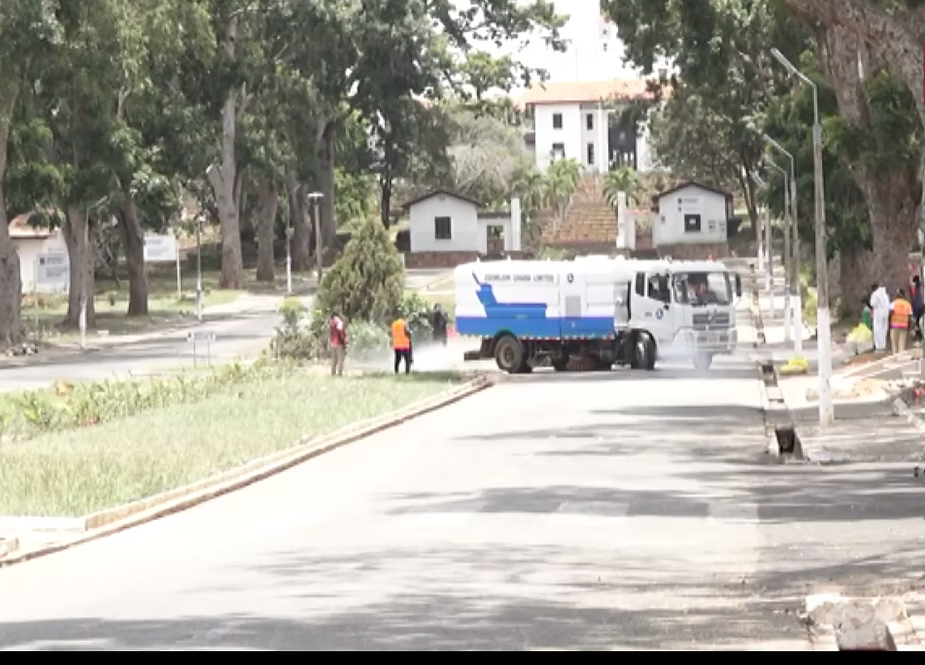
Zoomlion executed its fumigation contracts by spraying chlorine solution on streets, open markets and school compounds, including tarred streets.
On indoor fumigation, the WHO guidelines said:
“In indoor spaces, routine application of disinfectants to environmental surfaces by spraying or fogging (also known as fumigation or misting) is not recommended for COVID-19. One study has shown that spraying as a primary disinfection strategy is ineffective in removing contaminants outside of direct spray zones. Moreover, spraying disinfectants can result in risks to the eyes, respiratory or skin irritation and the resulting health effects. Spraying or fogging of certain chemicals, such as formaldehyde, chlorine based agents or quaternary ammonium compounds, is not recommended due to adverse health effects on workers in facilities where these methods have been utilised.”
Regarding outdoor fumigation, the WHO guidelines said:
“Spraying or fumigation of outdoor spaces, such as streets or marketplaces, is also not recommended to kill the COVID-19 virus or other pathogens because disinfectant is inactivated by dirt and debris and it is not feasible to manually clean and remove all organic matter from such spaces. Moreover, spraying porous surfaces, such as sidewalks and unpaved walkways, would be even less effective. Even in the absence of organic matter, chemical spraying is unlikely to adequately cover all surfaces for the duration of the required contact time needed to inactivate pathogens. Furthermore, streets and sidewalks are not considered to be reservoirs of infection for COVID-19. In addition, spraying disinfectants, even outdoors, can be harmful for human health.”
Contradiction by Minister of State

Ghana’s first COVID-19 fumigation in April 2020 was greeted with questions about its efficacy in combating the pandemic. The fumigation began with Zoomlion’s open-market fumigations, during which chlorine solution was splashed onto streets and open spaces. Some personnel also used handheld sprayers to spray fumes into open spaces. This raised questions about the effectiveness of the exercise in curtailing the virus.
In a response, the Deputy Minister for Local Government and Rural Development, O.B. Amoah, told an Accra-based Kasapa FM in an interview that the exercise was not targeted at the coronavirus. He said the Ministry and the assemblies had, over the years, been conducting fumigation exercises and that the one in April 2020 only coincided with the outbreak of the pandemic.
“Whoever says this spraying is meant to kill the virus is not being truthful,” Mr Amoah said.
“So does it mean this spraying isn’t done because of the coronavirus?” the journalists asked.
“This is not a spraying against coronavirus…Whoever is saying this spraying is against the coronavirus is not being truthful,” Mr Amoah insisted.
The journalist asked again: “Was this a planned spraying exercise that coincided with the coronavirus outbreak?”
“Yes, it coincided with the outbreak of the coronavirus,” Mr O. B. Amoah said.
Multiple existing fumigation contracts
According to information from the WHO and Ghanaian scientists, Ghana’s COVID-19 fumigation was needless. Even if fumigation was necessary, there were enough existing fumigation contracts to meet that need.
Zoomlion Ghana Limited had a standing contract with all the metropolitan, municipal and district assemblies (MMDAs) in Ghana to undertake monthly fumigation and disinfection of markets, lorry parks, public toilets, among others.
The Zoomlion-MMDAs fumigation contract, signed between the company and individual assemblies, had been running since 2010, and payment for the contract was deducted at source from the assemblies’ share of the Common Fund. This fumigation has been flagged by the Auditor-General on multiple occasions.
The Public Accounts Committee of Parliament ordered its cancellation in 2022 due to repeated infractions by the company, as captured in the annual Auditor-General reports.
The December 2025 report by the three ministers said the following of the nationwide fumigation contracts which already existed when the COVID-19 fumigation contracts were awarded:
“All two hundred and fifty-three (253) Fumigation Agreements should be cancelled with immediate effect on the following grounds:
“GOG [Government of Ghana] does not receive value for money on these Agreements and there is the need to chart a new path that will ensure value for money, accountability and fair treatment of workers;
“There have been incessant complaints about monies paid for no work done or chemicals used whose quality could not be confirmed.”
The contract was terminated in 2025 after investigations and a petition to the President by this reporter, which occasioned the ministerial report.
During the COVID-19 fumigations, the Ministry of Health had another contract with Zoomlion to undertake fumigation in all 260 metropolitan, municipal and district assemblies in the country. Payment for this contract is made by the National Health Insurance Authority. This contract has existed since 2009. This second fumigation exercise, like the MMDAs contract with Zoomlion, is also supposed to be carried out at the assembly level, meaning the two fumigations covered all parts of Ghana.
The second nationwide fumigation contract is fraught with allegations of corruption. The Auditor-General in 2019 disallowed and surcharged payments made under this contract to the tune of 184 million cedis. Zoomlion challenged it in the High Court. The court ruled in favour of the Auditor-General. Zoomlion won an appeal at the Supreme Court on technical grounds, not on the substance of the audit.
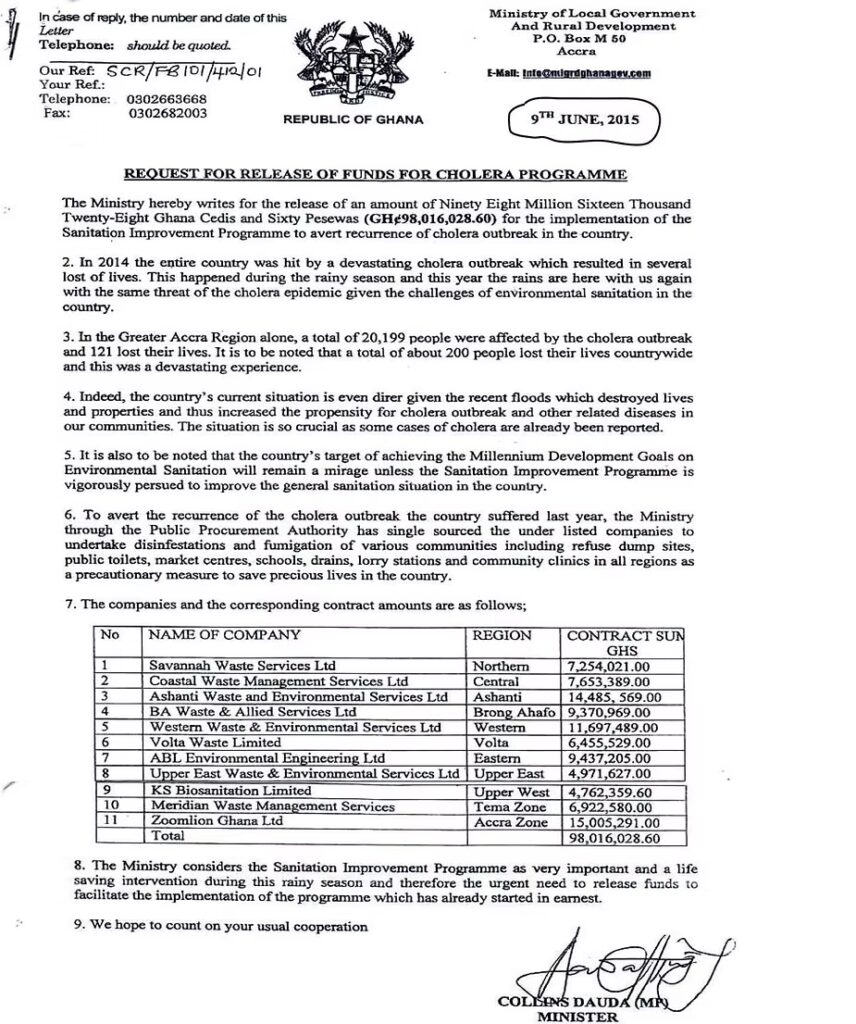
Aside from the two nationwide fumigation contracts with Zoomlion, the Ministry of Local Government and Rural Development awarded a third contract annually to be undertaken at the assembly level, bringing the total to three contracts awarded to the same company for the same place.
The ministry said it awarded the third fumigation contract to Zoomlion in 2014, 2015, 2016 and 2017 to stop the spread of cholera.
In 2020, COVID-19 was the reason for awarding a third national fumigation contract to the same company.
Capable MMDAs forced to stop COVID-19 fumigation

When the COVID-19 pandemic broke out, many metropolitan, municipal and district assemblies developed their own capacities to fumigate and disinfect public spaces and places. This was in addition to the two existing contracts they and the central government had signed with Zoomlion. The government asked the assemblies to stop their fumigation exercises so that Zoomlion could undertake the new COVID-19 fumigation contracts.
The Chief Executive Officer of the Kumasi Metropolitan Assembly told me his assembly had 100 spraying machines. The assemblies were asked to allow Zoomlion to fumigate their public spaces.
The sanitation department of Accra Metropolitan Assembly, with the support of UNICEF, was spraying markets, lorry parks and public places. In July, however, the assembly was asked to suspend its spraying so that Zoomlion could conduct the second phase of the Local Government Ministry, according to Mohammed Adjei Sowah, the Mayor of Accra at the time.
At the Afram Plains North District Assembly, the District Chief Executive, Samuel Ohene Kena, revealed that even without Zoomlion’s existing contracts, the assembly’s sanitation department was well-equipped to have carried out the COVID-19 fumigation of the markets.
A tainted company
Zoomlion’s operations in Ghana and abroad have been characterised by malfeasance and corruption. In 2013, the World Bank blacklisted Zoomlion from participating in any World Bank-funded project for two years. The World Bank said the ban was imposed following Zoomlion’s “acknowledgement of misconduct impacting the World Bank-financed Emergency Monrovia Urban Sanitation Project in Liberia. The company paid bribes to facilitate contract execution and processing of invoices.”
In 2013, the GYEEDA Corruption Scandal this reporter investigated revealed that Zoomlion was deeply involved. A two-year sanitation contract that expired in February 2013 was found by a government of Ghana investigative committee to have been inflated by at least 74 million cedis or 21 million US dollars at the time.
The committee recommended a discontinuation of the contract, but the government did not act on the findings. The Akufo-Addo-led government allowed it to continue even though a new contract was signed after it had expired in 2013.
Between 2013 and 2019, that deal cost the nation 1.62 billion cedis or 400 million US dollars (per the exchange rate at the time) without any written agreement.
The contract was discontinued in 2025 after a directive by President John Dramani Mahama.
Zoomlion has, since 2017, stopped responding to requests for comments from this reporter after its CEO, Joseph Siaw Agyepong, chickened out of a defamation suit.
Following this reporter’s “Robbing the Assemblies” investigative documentary in 2017, the Financial Forensics Unit of the Ghana Police Service found that at least 200 million cedis was paid to Zoomlion and its subsidiary companies for fumigation, but no official of the ministry could attest to or certify that work was done.
The docket of the police investigation was presented to the Minister of Justice and Attorney-General more than a year ago, but nothing has happened.
The findings of the documentary, however, resulted in the cancellation of a $74 million contract awarded to sister companies of Zoomlion to supply waste bins, despite an earlier procurement which the ministry could not distribute.
Zoomlion CEO Joseph Siaw-Agyepong has publicly cited his connections with various presidents and governments and how they have supported his operations.
The COVID-19 fumigation expenditure, which the Auditor-General understated, reflects a familiar pattern of state institutions and government officials looking away while the company engages in acts that cause the nation to lose money. This point was strongly made by the three ministers in their “secret” memo to cabinet, which I obtained as part of this investigation:
“It must be pointed out that ZL [Zoomlion] could not have entered into these Agreements without the concurrence or acquiescence of officers of the Ministries, Departments and Agencies in the sanitation sector, as well as the District, Municipal and Metropolitan Assemblies. Some of the terms of the Agreements in question are not acceptable to the officials in these MDAs and MMDAs, and it is important that guidelines are clearly mapped out going forward.”
-
This report was produced under the Pledge Against Corruption Ghana project. The civil-society led project has the Africa Centre for Energy Policy, Transparency International Ghana and the Ghana Anti-Corruption Coalition as partners and is supported by the UK International Development.
Latest Stories
-
Cedi weakens as forex demand outpaces interbank supply; one dollar equals GH¢11.95
11 seconds -
Former KPMG boss Joseph Winful says some COVID-19 fumigation contracts may have been abuse of office
1 minute -
Police to fully roll out automated traffic enforcement from October 1
7 minutes -
Photos: Mahama commissions Phase Three of Zonda Tech vehicle assembly plant
10 minutes -
47 Nigerian nationals rescued from suspected trafficking networks in Goaso
16 minutes -
Petrol prices could jump nearly 10% from Sept 16 – COPEC
23 minutes -
Sunyani, Kwahu Obomeng get customary land secretariats to improve transparency and land records
25 minutes -
Why millet could be good for your heart, digestion and blood sugar
33 minutes -
Okyeame Kwame named new brand ambassador for Rosa Tiles
37 minutes -
Ghana to host high-level reparatory justice event at 81st UNGA
39 minutes -
NAIMOS steps up response to alleged illegal mining in Atewa Forest Reserve
40 minutes -
Police commend Kpando MCE for rehabilitating District Headquarters
1 hour -
Government adjusts border security and narcotics meeting invitations after Sammi Awuku raises concerns
1 hour -
Zonda Tec expansion to create 1,000 indirect jobs – Mahama
1 hour -
Kit Up Ghana Foundation donates jerseys to Achimota Basic School
1 hour