

Audio By Carbonatix
Cocoa farmers in parts of the Ashanti Region have welcomed the passage of the Ghana Cocoa Board Bill, 2026, expressing support for key reforms aimed at protecting farmers’ interests and strengthening the long-term sustainability of Ghana’s cocoa industry.
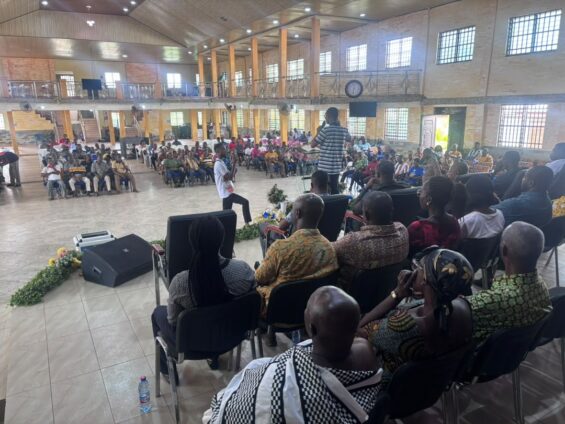
The farmers, drawn from Juaben, Asiwa, Juaso, and Konongo, expressed their support during a major stakeholder sensitization rally organized by the Ghana Cocoa Board (COCOBOD) at Konongo, barely a week after Parliament passed the Bill.
The engagement, which attracted more than 400 participants, marked the first major farmers’ rally in the cocoa-growing regions following the passage of the Bill and formed part of COCOBOD’s programme to take accurate information on the legislation directly to farmers and other grassroots stakeholders.
The discussions were led by the Executive Director of the Cocoa Health and Extension Division (CHED), Dr. Richard Adu Acheampong, and the Deputy Head of Public Affairs, Mr. Benjamin Teye Larweh, who took participants through the rationale for the new legislation, its major provisions, and the expected benefits to farmers and the wider cocoa industry.
Key areas highlighted included farmer welfare, producer pricing, protection of cocoa farms, measures against illegal land destruction, and cocoa smuggling, cocoa-sector financing, the Cocoa Farmers Pension Scheme, educational support for farmers’ children, local processing, stakeholder participation, and measures to strengthen governance and financial sustainability within the sector.
Misconceptions Clarified
The engagement also provided an opportunity to address some misconceptions surrounding the Bill, particularly claims that farmers would no longer be permitted to cultivate food crops on their cocoa farms or that COCOBOD could take over farmers’ lands.
Farmers were assured that the Bill does not prohibit the cultivation of compatible food crops alongside cocoa. Intercropping remains an important recommended agronomic practice, particularly during the establishment of young cocoa farms, where crops such as plantain and other compatible food crops may provide temporary shade while supporting farmers’ livelihoods.
It was further clarified that the Bill does not transfer ownership of cocoa farms to COCOBOD. Rather, its protective provisions are intended to safeguard cocoa farms against unlawful destruction and permanent conversion to incompatible uses, particularly illegal mining and other activities that threaten farmers’ investments and the sustainability of cocoa production.
MCE Commends COCOBOD’s Grassroots Engagement
Addressing the gathering, the Municipal Chief Executive for Asante Akim North, Hon. Sarah Amoako, acknowledged the enormous contribution of the cocoa industry and cocoa farmers to Ghana’s socioeconomic development over the years.
She commended COCOBOD for taking the sensitization exercise to the grassroots, noting that direct engagement with farmers was critical to ensuring that those most affected by the reforms understood the provisions of the Bill and had the opportunity to seek clarification on issues of concern.
The MCE also drew attention to the provision of the Bill that seeks to refocus COCOBOD on its core mandate by restricting the institution from undertaking quasi-fiscal activities, including the construction of cocoa roads.

She therefore urged farmers and residents of cocoa-growing communities to engage their respective Metropolitan, Municipal, and District Assemblies on road infrastructure and other development challenges that fall within the responsibility of central and local government.
According to her, this would enable COCOBOD to concentrate its resources and attention on its core responsibility of regulating, developing, and promoting Ghana’s cocoa industry, while the appropriate state institutions address broader community development needs.
Farmers Welcome Reforms, Call for Continued Engagement
Farmers actively participated in the discussions and welcomed the opportunity to engage directly with COCOBOD officials on the new legislation.
They sought clarification on a wide range of issues, including the Cocoa Farmers Pension Scheme, educational support for farmers’ children, illegal mining, cocoa roads, compensation, agricultural financing, cocoa weighing scales, planting materials, farm rehabilitation, and farmer participation in decision-making.
The farmers welcomed the reforms and called for sustained sensitization and consultation to ensure that cocoa farmers across the country fully understand the provisions of the new legal framework and how the reforms will affect their livelihoods.

The meeting was also attended by the District Coordinating Director and Presiding Member of the Asante Akim Central Municipal Assembly, the Ashanti Regional COCOSHE Secretary, the Konongo District Chief Farmer, local media, and other stakeholders.
Latest Stories
-
Education Minister engages university administrators over ongoing strike
37 minutes -
Technological convergence, disruptive innovation and the future of youth education in Ghana
1 hour -
When the sirens become a national anthem: confronting Ghana’s road accident crisis
2 hours -
Aksa bribery scandal exposes deeper failures in Ghana’s procurement system – Manhyia South MP
2 hours -
Luv FM High School Debate: KNUST, St. Louis strike gold as quarter-finals dreams come alive
2 hours -
Banks’ pre-tax profit jumps 40% to GH¢23bn
2 hours -
Luv FM High School Debate: Anticipation builds as schools battle for supremacy in Round of 16
2 hours -
Banking sector deposits jump 25% to GH¢334.3bn in 2025 — PwC
3 hours -
Hostel Owners Association bares teeth over legality of rent control campaign against exorbitant fees
3 hours -
GCB overtakes Ecobank as Ghana’s largest deposit-taking bank
3 hours -
Young Cocoa Farmers petition Mahama over funding, producer price and start date for new cocoa season
3 hours -
Ruha Benjamin challenges Africa to shape its own AI future
3 hours -
Trump threatens to bomb US ally Oman if it ‘gets in the way’ over Iran deal
3 hours -
FIFA sacks senior executive who criticised Infantino, Sky News understands
3 hours -
Aksa saga: Don’t turn EOCO-OSP roles into turf war – Deputy AG
3 hours