

Audio By Carbonatix
A senior police officer has warned politicians against distributing food and other items during elections, describing such acts as potential vote buying and urging citizens to reject practices that undermine the integrity of Ghana’s democratic process.
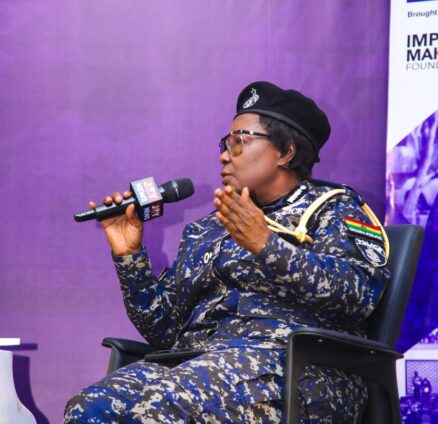
ACP Brown Mercy Wilson, Head of Legal and Prosecution for the Volta Region, made the comments at the JoyNews’ “Democracy Is Not For Sale” forum organised by the JoyNews Impact Makers Foundation.
According to her, politicians who engage in such activities during elections create an environment that could compromise free and fair decision-making by voters.
"When a politician is holding packs of food and sharing during an election, that politician is not a nice person. That environment is a crime scene," ACP Wilson stated.
She urged politicians and public figures to be conscious of their conduct, particularly actions that could influence voters through material inducements.
"We are not supposed to do things that will, for want of a better explanation, offend the sense of decency of people who look to you when you are doing your things or when you are saying your things. Don't do things that will offend their own sense of decency," she said.
Her comments come amid growing national discussions about the influence of money and inducements in Ghana’s electoral processes.
The “Democracy Is Not For Sale” forum series, organised by the JoyNews Impact Makers Foundation, has brought together political actors, civil society organisations, legal experts and citizens to discuss concerns surrounding vote buying and the monetisation of politics.
A pre-forum survey conducted by JoyNews ahead of the Volta Regional edition showed that many respondents were aware of vote buying, with some indicating that they had witnessed politicians or their agents offering money and other incentives to influence electoral choices.
Under Ghana’s electoral laws, vote buying and voter inducement are criminal offences. Sections 240 and 241 of the Criminal Code, 1960 (Act 29), together with provisions under the Representation of the People Act, 1992 (PNDCL 284), prohibit the buying and selling of votes in public elections.
However, concerns have been raised about gaps in the law regarding internal political party elections, as party primaries are not classified as public elections under existing legislation.
This has led to calls from governance experts and civil society groups for reforms to extend legal sanctions against inducements beyond general elections.
The Office of the Special Prosecutor has also expressed interest in investigating allegations of vote buying linked to political party primaries.
Latest Stories
-
Big Push probe: Presidential staffer challenges Fourth Estate’s report on Valerie Sawyerr committee
36 minutes -
Since Gold Coast, national security has never faced an open trial – Atta Akyea
36 minutes -
This is no case for junior lawyers – Atta Akyea explains why he must defend Adu-Boahene
55 minutes -
Lebanon parliament votes to abolish death penalty
56 minutes -
Ghana, Burkina Faso sign defence pact to secure cross-border trade corridors
1 hour -
The rise of AI in the classroom: Balancing technological innovation with critical thinking
1 hour -
Five arrested over alleged MoMo robbery syndicate in Upper West
1 hour -
UEW journalism students call for practical media studio
2 hours -
Why these 2 cases? – Atta Akyea questions Chief Justice’s expedited trial order
2 hours -
Beyond certification: How Bawaa the artist is helping young creatives turn talent into opportunity
2 hours -
The Law 101: Vacation warrants and the role of the CJ (Part IV)
2 hours -
The Law 101: GBA states pure law and convention about Legal Vacation (Part III)
2 hours -
Pray – THE LAW 101: The Vacation Roster dilemma and the reality of Court Recess (Part II)
2 hours -
Trump hid in catering truck in secret plane swap over Iran threat, reports say
2 hours -
Inside the Secret Service ‘shell game’ to hide US presidents in plain sight
2 hours