


Audio By Carbonatix
Director of Audit at the Ghana Audit Service, Hannah Mensah, has urged journalists to look beyond how much public money is spent when assessing the performance of government institutions and projects.
Speaking during a media training, held in Accra on Monday, September 28, she said accounting for funds does not necessarily demonstrate that the resources have achieved their intended purpose, stressing the need to examine whether expenditure translates into the expected results.
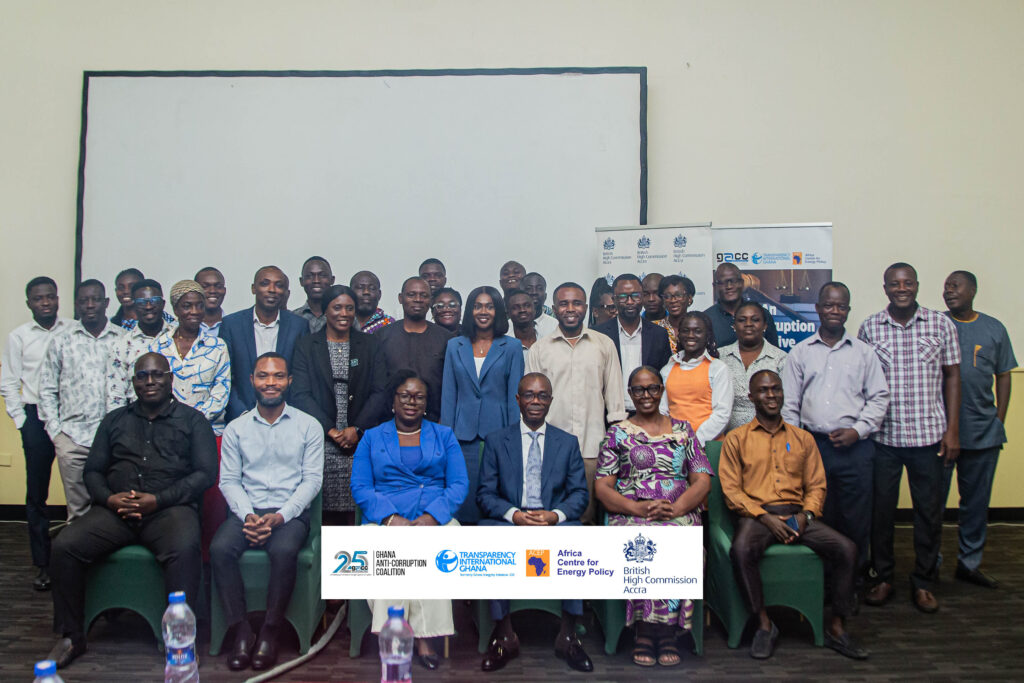
Ms Mensah made the remarks during a media training on the Auditor-General’s Performance Audit Report on the operations of the National Petroleum Authority (NPA), where she took participants through the principles and approach to performance auditing.
Using a hypothetical example of a government institution that spends 100 million on a project, Ms Mensah explained that an institution may be able to account for every amount spent without necessarily delivering the expected outcomes.
“Spending is different and the project deliverables are also different,” she said.
She added: “So, it doesn't necessarily mean that if I spend 100 million and I'm able to account for it, everyone's needs have been met.”
According to Ms Mensah, this distinction is at the heart of performance auditing, which seeks to establish how well resources have been converted into the intended results.
She explained that performance auditing examines not only the resources used but also the systems, processes and activities through which those resources are expected to produce results.
Ms Mensah said the assessment is guided by the principles of economy, efficiency and effectiveness, which help auditors determine whether resources were acquired and used appropriately, whether they were used to achieve intended objectives and whether the most was made from them.
She further explained that performance could be assessed through an input-output relationship, where financial, human and material resources serve as inputs that are channelled through specific activities to produce outputs and ultimately achieve intended outcomes.
Ms Mensah used the recruitment and deployment of staff as an example, saying auditors would consider whether personnel were recruited at the right cost, whether they had the expertise required for the task, whether they were recruited at the appropriate time and whether the number of staff was adequate.
“Have you recruited them with regards to the appropriate cost, the right cost, as in how much we are paying them?” she asked.
She added: “The quality of the staff, do they have the expertise to do that activity? Did we get them at the right time?”
Ms Mensah also cautioned against equating the completion of an activity with the achievement of an intended outcome.
She explained that if staff were assigned to monitor a number of filling stations, for instance, the completion of the monitoring exercise would only constitute an output. It would still be necessary to establish whether the monitoring achieved the purpose for which the resources were deployed.
She therefore encouraged journalists examining audit reports to ask why particular activities were undertaken and whether they produced the expected results.
“What was the objective of asking these staff, these resources to go and carry out that monitoring activity?” she asked.
Ms Mensah said journalists should apply this approach when interpreting the NPA audit report rather than focusing only on expenditure figures or activities recorded in the report.
She also urged journalists to be careful when describing audit observations as findings, explaining that an observation is only the starting point for further examination.
According to her, simply reporting the difference between the expected and actual figures would not constitute a complete finding.
Ms Mensah explained that auditors must examine the difference between what should have happened and what the evidence shows actually happened, before investigating the reasons for the gap.
“This observation needs to be further assessed in finding out why is this so,” she said.
She stressed that journalists should similarly avoid drawing conclusions from an observation without examining the circumstances that produced it.
“We don't only base our conclusions on what is supposed to be the case, it’s just an observation which needs to be scrutinised,” she said.
Ms Mensah said this process requires examining the different factors surrounding an issue through what she described as root cause analysis.
“Because a lot of things go into it. So we do what we call a root cause analysis,” she said.
She urged journalists to approach audit reports holistically and take the different aspects of an issue into consideration before drawing conclusions.
“If you look at our reports in this holistic view, you take into consideration all of the aspects,” she said.
The training formed part of a programme organised by the Ghana Anti-Corruption Coalition (GACC) in partnership with the Africa Centre for Energy Policy (ACEP) and Transparency International-Ghana, with support from the Foreign, Commonwealth and Development Office.
Latest Stories
-
Two bodies stuck at St. Anne’s mortuary after refrigeration engines break down
13 minutes -
‘We will not let this matter rest’ – Afenyo-Markin after Bagbin rejects narcotics probe
16 minutes -
AFCON 2027Q: Ghana suffer 4-2 defeat to Gambia
20 minutes -
Your strike could disrupt academic calendar – GES urges teachers to return
28 minutes -
Speaker’s ruling has failed integrity test required of Parliament to discharge its duties – Afenyo-Markin
57 minutes -
St. John’s Grammar edges Mfantsipim in nail-biting NIQ showdown
1 hour -
Expanding Financial Inclusion: Advans Ghana’s client base more than doubles to 160,000
1 hour -
AFCON 2027Q: Ghana surrender two-goal lead to lose to Gambia
1 hour -
Daily Insight for CEOs: Preparing the organisation for 2027
1 hour -
‘Don’t just sit silent and expect a referral’ – Speaker urges Human Rights Committee to investigate abuses
1 hour -
‘Give caucus leaders adequate time to speak before ruling’ – Afenyo-Markin to Bagbin
2 hours -
Petrosol gives back to society by donating 3,600 books and bags to Sawla DA Primary
2 hours -
Bagbin dismisses Minority motion on narcotics seizures as inadmissible
2 hours -
From Oversight to Impact: Why board committees will make or break Africa’s organisations
2 hours -
‘Strong criticism is legitimate but insult is not argument’ – Speaker urges restraint in public discourse
2 hours