


Audio By Carbonatix
The home of Sri Lanka's Prime Minister Ranil Wickremesinghe has been set on fire.
This follows a protest outside the home of the Prime Minister.
Over the past hour the unrest between protesters and police has intensified outside Wickremesinghe's residence in the country's capital Colombo.
🔴 #SriLankaProtests | Prime Minister Ranil Wickremesinghe's residence set on fire pic.twitter.com/jWs33YBhzY
— NDTV (@ndtv) July 9, 2022
As the protests continue, the exact location of Sri Lanka's President Gotabaya Rajapaksa remains unknown after he earlier fled his official residence.
The property in the country's capital Colombo has since been stormed by large crowds with protesters demanding his resignation.
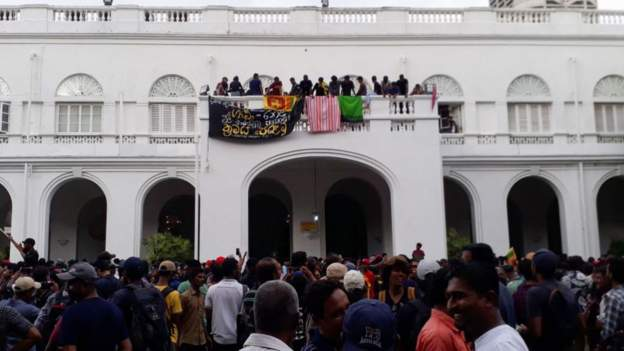
Rajapaksa was escorted to safety after people gathered outside the gates, and he is being protected by a military unit, a top defence source told the AFP news agency.
Protestors taking a dip in the pool at President’s House. pic.twitter.com/7iUUlOcP6Z
— DailyMirror (@Dailymirror_SL) July 9, 2022
But speaking to Newshour on the World Service from Colombo, the BBC'S Ranga Sirilal explained that no-one knows where the president is.
He said there are claims Rajapaksa is trying to flee Sri Lanka "at any moment" and that he is at the airport.
However, there are other reports that he's next to Colombo Port amid claims "that two ships that docked at the port were seen loading some travelling bags, suggesting that the president is going to leave".
What seems more certain, Sirilal added, is that it appears protesters won't leave the residence until the president resigns and there is some political stability.
Why is Sri Lanka in an economic crisis?
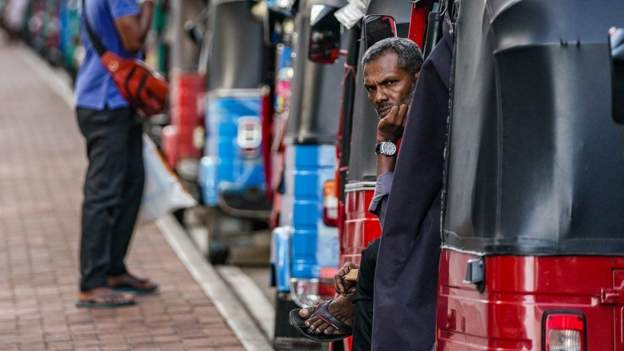
The storming of the Sri Lankan president's official residence today comes after months of protests as the country literally ran out of foreign currency.
This meant basics, including fuel, food and medicine, have been increasingly scarce.
This led the Sri Lankan government to suspend sales of fuel to ordinary people until Sunday. It's thought to be the first country to do so since the 1970s.
Last weekend, officials said it had less than a week's worth of fuel left for essential services like buses, trains and medical vehicles.
Schools have closed and the country's 22 million residents have been asked to work from home.
Shortages of food and fuel have caused prices to soar. Inflation is now running at 30%.
There have been power cuts, and the lack of medicines has brought the health system to the verge of collapse.
Latest Stories
-
Ghana’s global image boosted by our world-acclaimed reset agenda – Mahama
6 minutes -
Full text: Mahama’s New Year message to the nation
7 minutes -
The foundation is laid; now we accelerate and expand in 2026 – Mahama
27 minutes -
There is no NPP, CPP nor NDC Ghana, only one Ghana – Mahama
29 minutes -
Eduwatch praises education financing gains but warns delays, teacher gaps could derail reforms
42 minutes -
Kusaal Wikimedians take local language online in 14-day digital campaign
1 hour -
Stop interfering in each other’s roles – Bole-Bamboi MP appeals to traditional rulers for peace
2 hours -
Playback: President Mahama addressed the nation in New Year message
2 hours -
Industrial and Commercial Workers’ Union call for strong work ethics, economic participation in 2026 new year message
4 hours -
Crossover Joy: Churches in Ghana welcome 2026 with fire and faith
4 hours -
Traffic chaos on Accra–Kumasi Highway leaves hundreds stranded as diversions gridlock
4 hours -
Luv FM Family Party in the Park: Hundreds of families flock to Luv FM family party as more join the queue in excitement
4 hours -
Failure to resolve galamsey menace could send gov’t to opposition – Dr Asah-Asante warns
4 hours -
Leadership Lunch & Learn December edition empowers women leaders with practical insights
5 hours -
12 of the best TV shows to watch this January
5 hours